


What Is the Axis on Prescription Glasses:
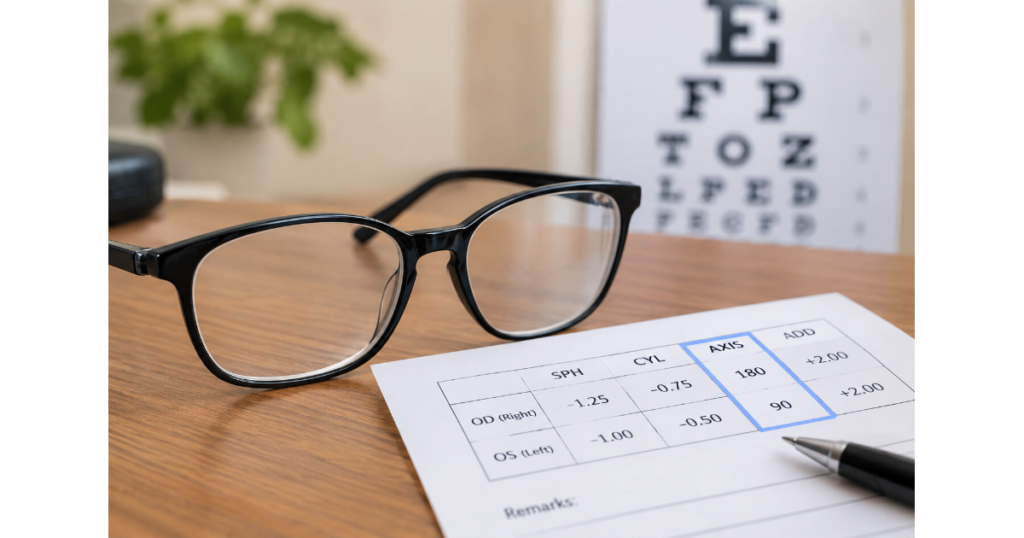
If you have ever picked up your eyeglass prescription and stared at a row of unfamiliar numbers and abbreviations, you are not alone. Most people can figure out that a bigger number next to SPH probably means a stronger prescription, but the AXIS column tends to confuse almost everyone, mostly because it looks like it should not even matter. Unlike SPH or CYL, the axis is not a power measurement at all. It is a direction, written in degrees, that tells the lens lab exactly how to position the correction inside your lens, so it lines up with the shape of your eye. Getting this number even slightly wrong can leave you with blurry vision, eye strain, or headaches, even if every other part of the prescription is perfect. This article explains exactly what the axis on glasses means, why it only shows up for certain people, and how it works together with the rest of your prescription to give you clear, comfortable vision.


Understanding What the Axis Actually Means
The axis eye prescription meaning comes down to one simple idea: it describes the orientation of astigmatism correction in your lens, measured in degrees from 1 to 180. Astigmatism happens when the cornea, or sometimes the lens inside the eye, is shaped more like a football than a basketball, curving more steeply in one direction than the other. This uneven curvature causes light to focus at two different points instead of one, which blurs or distorts vision at every distance. The axis number tells the lab exactly which direction that irregular curve is running, so the cylindrical correction can be placed at the precise angle needed to cancel it out. Without the axis, a lens with cylinder power would just be rotated randomly, which would do almost nothing to fix the blur and could even make vision worse.
What Is Axis on Glasses and Why It Only Appears Sometimes
A lot of people notice that their prescription has an axis number while a friend’s does not, and this is completely normal. The axis only appears on a prescription when there is a cylinder, or CYL, value listed next to it, because the axis has no purpose on its own. If someone has no astigmatism, their eyes focus light evenly in every direction, so there is nothing for an axis to describe, and that column is usually left blank or marked with a dash. Once astigmatism is present, though, the axis becomes just as important as the power numbers themselves, since it tells the optician precisely how to align the lens during grinding and fitting. This is why two people with the exact same cylinder power can end up needing completely different lenses, simply because the direction of their astigmatism is different.
How Axis Relates to Astigmatism Orientation
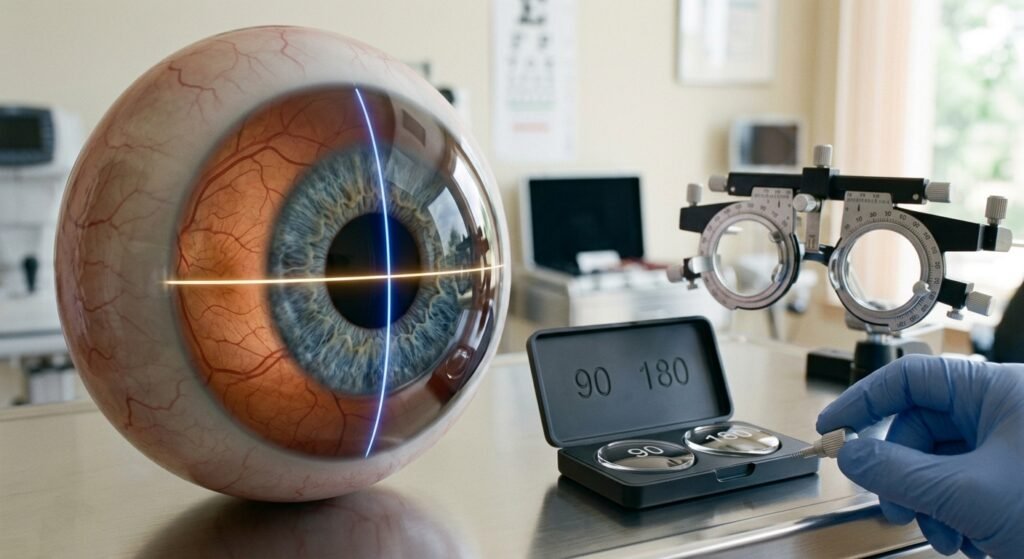
Astigmatism axis orientation is really just a way of mapping the steepest and flattest curves of the eye onto a 180-degree scale, similar to a protractor. Picture the front of the eye as a clock face turned into a straight line running from 1 to 180 degrees, with 90 degrees marking straight up and down, and 180 degrees marking straight across horizontally. The axis number tells you exactly where along that scale the irregular curvature sits, which in turn tells the lens maker where to place the cylindrical power so it lines up with the eye’s natural shape. Even a small error here, sometimes as little as 10 to 15 degrees off, can noticeably distort vision, because the correction ends up fighting against the eye’s curvature instead of matching it. This is part of the reason eye exams for astigmatism take a bit longer than a standard check, since the doctor needs to fine-tune this angle carefully.
Breaking Down an Eye Prescription: SPH, CYL, and Axis
Learning how to read eyeglass prescription numbers becomes much easier once you understand that each column answers a different question. SPH, short for sphere, tells you how much lens power is needed to correct basic nearsightedness or farsightedness, written in diopters with a plus or minus sign. Sphere diopters represent how strongly the lens bends light to focus images properly on the retina, and this number applies evenly across the entire lens surface. CYL, or cylinder lens power, comes into play only when astigmatism is present, and it represents the additional lens power needed to correct that irregular curvature, also measured in diopters.
The eye prescription AXIS vs CYL relationship is where a lot of confusion happens, but it is actually straightforward once broken down. CYL tells you how much extra correction is needed for astigmatism, while axis tells you where that correction needs to be placed. Think of CYL as the strength of a fix and axis as the exact angle at which that fix has to sit. Both numbers depend on each other completely, since a cylinder value without an axis is meaningless, and an axis without a cylinder value has nothing to describe.
| Prescription Term | What It Measures | Written As |
|---|---|---|
| SPH (Sphere) | Overall focusing power for near or farsightedness | Diopters (+ or -) |
| CYL (Cylinder) | Extra power needed to correct astigmatism | Diopters (+ or -) |
| AXIS | Direction of the astigmatism correction | Degrees, 1 to 180 |
| ADD | Extra magnification for reading or bifocals | Diopters (+) |
Vertical vs Horizontal Meridian in the Eye
To really understand why axis matters, it helps to know a bit about the vertical vs horizontal meridian eye structure. The cornea and lens of the eye have two main curves running perpendicular to each other, called meridians, and in a perfectly round eye these two curves would be identical. With astigmatism, one meridian curve more sharply than the other, and eye doctors measure exactly where these two meridians sit using specialized instruments during a comprehensive eye exam. The steeper meridian bends light more strongly, creating a second focal point that causes the blur associated with astigmatism. The axis value marks the meridian that does not need correction, while the cylinder power is applied 90 degrees away, at the meridian that actually needs the extra bending force to bring light into a single, sharp focus point.
What Causes Astigmatism and Corneal Irregularities
Most astigmatism traces back to the natural shape of the cornea, the clear, dome-shaped front surface of the eye. Cornea irregular curvature is usually present from birth and tends to run in families, though it can also develop or change slightly after an eye injury, surgery, or certain corneal conditions like keratoconus. In keratoconus, the cornea gradually thins and bulges into a cone-like shape, which creates a much more complex and often higher degree of astigmatism than the mild, regular kind most people have. This is one of the reasons regular eye exams matter, since sudden changes in your axis or cylinder numbers between visits can sometimes be an early sign of a corneal condition that needs closer monitoring rather than just a routine prescription update.
How Axis Fits Into Refractive Error Correction
Refractive error correction is really just the broad term for any lens adjustment that helps light focus properly on the retina, and astigmatism correction is one piece of that larger puzzle. Nearsightedness and farsightedness are refractive errors related to the overall length of the eye or the curvature of the cornea in a uniform way, which is why SPH alone can fix them. Astigmatism, on the other hand, is a refractive error tied to uneven curvature, which is why it needs both a cylinder power and an axis working together rather than a single spherical number. Many people actually have a combination of nearsightedness or farsightedness along with astigmatism, which is why most prescriptions include SPH, CYL, and axis all listed side by side for each eye.
Why Correct Axis Alignment Matters So Much
Getting the axis right is not just a technical detail for the lab; it directly affects how clearly and comfortably you see through your new glasses. Even a lens ground with the exact right SPH and CYL power will not correct vision properly if the axis is off, because the cylindrical correction will be sitting at the wrong angle relative to the eye’s actual astigmatism. People with an incorrect axis often describe symptoms like blurry or doubled vision, eye strain after short periods of reading or screen use, headaches, and a general sense that something is just not quite right, even though they cannot always pinpoint what. This is part of why optician lens alignment during the fitting and grinding process is such a precise task, and why reputable optical labs double-check axis placement before a pair of glasses ever leaves the shop.
Do’s and Don’ts When Dealing With Your Axis Prescription
Since axis errors are not always obvious right away, it helps to know how to protect yourself when getting new glasses made.
| Do | Don’t |
|---|---|
| Double-check your prescription copy before ordering | Assume every optical shop copies numbers perfectly |
| Ask your optician to confirm axis and CYL together | Ignore blurry vision after picking up new glasses |
| Get a comprehensive eye exam if astigmatism is suspected | Rely on outdated prescriptions for a new pair |
| Mention any doubling or eye strain right away | Wait months before reporting discomfort |
| Request a recheck if something feels off | Assume the problem is just “getting used to” new lenses |
| Keep a copy of your prescription for reordering online | Guess your axis number when buying glasses online |
Common Symptoms of an Incorrect Axis
Because the axis is a directional measurement rather than a simple power number, small errors can be surprisingly easy to overlook during a quick glance at a prescription slip, yet the effects are often very noticeable to the wearer. Symptoms typically include mild to moderate blurriness that does not fully clear up even after adjusting to new lenses, a subtle sense of visual distortion where straight lines look slightly tilted or curved, and eye fatigue that builds up over the course of a day, especially during close work like reading or using a computer. Headaches, particularly around the brow or temples, are another common complaint tied to axis errors, since the eyes have to work harder to compensate for a correction that is not quite lined up with their natural astigmatism. If any of these symptoms show up shortly after getting new glasses, it is worth going back to have the axis and cylinder rechecked rather than assuming it will resolve on its own.
Advantages and Disadvantages of Precise Axis Measurement
Modern eye exams use increasingly precise tools to measure axis and astigmatism, and while this precision offers real benefits, it also comes with a few trade-offs worth knowing about.
| Aspect | Advantages | Disadvantages |
|---|---|---|
| Detailed manual refraction | Highly accurate, tailored to patient feedback | Takes longer, requires patient cooperation |
| Automated corneal topography | Fast, objective, maps the whole corneal surface | Higher cost, not available at every clinic |
| Precise axis and CYL prescribing | Sharper vision, fewer follow-up adjustments | Small axis errors during lens-cutting still possible |
| Frequent prescription updates | Keeps correction accurate over time | More frequent exams needed for changing astigmatism |
How Axis Numbers Are Written and Read
Axis values are always written as a whole number between 1 and 180 degrees, without any plus or minus sign, since they represent a direction rather than a power. A reading of 90 degrees generally corresponds to the vertical meridian, while 180 degrees corresponds to the horizontal meridian, with every other number falling somewhere between those two references on the diagram opticians use. It is worth noting that an axis of 1 and an axis of 180 sit right next to each other on this scale, even though the numbers look far apart, because the scale essentially wraps around like a half-circle rather than a full circle. Understanding this helps explain why opticians are so careful when transcribing prescriptions, since a simple typo, like writing 18 instead of 180, can send the correction to a completely different angle and cause noticeable vision problems.
Getting an Accurate Eye Exam for Astigmatism
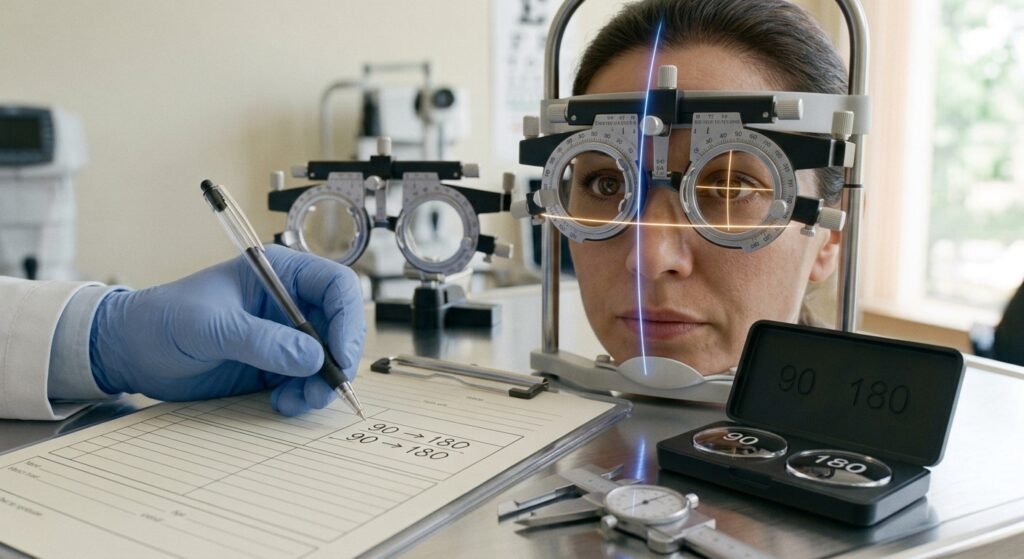
A thorough, accurate measurement of your axis starts with a proper eye exam, ideally one that includes both a subjective refraction, where you respond to different lens options, and an objective measurement using instruments like an autorefractor or corneal topographer. According to the American Academy of Ophthalmology, astigmatism can occur alongside nearsightedness, farsightedness, or on its own, and it is measured carefully as part of a comprehensive eye exam using specialized lenses that isolate the axis and cylinder power. It is generally a good idea to have your eyes examined every one to two years, or sooner if you notice any changes in vision clarity, since both the degree and the axis of astigmatism can shift slightly over time, particularly in younger patients or those with certain corneal conditions.
Ordering Glasses Online With an Axis Prescription
Buying glasses online has become increasingly popular, but it does require paying close attention to every number on your prescription, especially the axis. Since there is no optician physically checking your face and existing glasses for cues, any transcription error when entering your SPH, CYL, or axis values can result in a pair of glasses that looks fine but does not actually correct your vision properly. The American Optometric Association recommends keeping a written or digital copy of your current prescription and confirming it with your eye doctor before placing an order, particularly if your prescription includes any degree of astigmatism. Taking a few extra minutes to double check these numbers before submitting an order can save the hassle and expense of returning a pair of glasses that never quite feels right.
Final Thoughts
The axis on your eyeglass prescription might look like a small, throwaway number tucked next to more familiar terms like SPH and CYL, but it plays a huge role in whether your glasses actually deliver clear, comfortable vision. It exists specifically to describe the direction of astigmatism correction, working hand in hand with the cylinder power to counteract the eye’s natural irregular curvature. Understanding what axis means, why it only appears alongside a cylinder value, and how even small errors can lead to blurry vision or headaches makes it much easier to spot when something is not quite right with a new pair of glasses. Whether you are picking up glasses from a local optician or ordering online, taking the time to double check your full prescription, axis included, is one of the simplest ways to make sure your new lenses actually work the way they are supposed to.