

You bang your toe on the coffee table, or you catch your finger in a car door, and a few hours later a dark, swollen spot shows up right where it hurt. Most of the time you would not think twice about it. But what if you never remember hitting that spot at all, or what if it has been sitting there for weeks without shrinking? That small moment of doubt is exactly why so many people search for blood blister vs melanoma information in the middle of the night, half convinced they are overreacting and half worried they are not. The truth is that a blood blister and a melanoma can genuinely look alike at first glance, especially in that first week when both are just dark, round marks on the skin. This article walks through how to tell them apart calmly and accurately, what the medical ABCDE melanoma criteria actually mean in plain language, and when a spot on your skin is worth a same-week appointment rather than a wait-and-see approach.
Why These Two Things Get Confused So Often
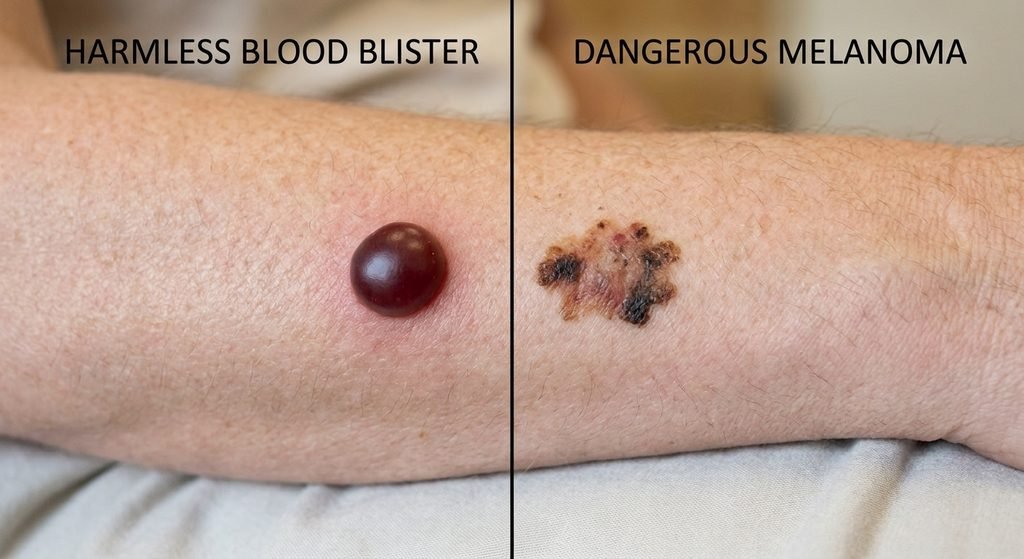
A blood blister forms when a blunt injury or repeated friction damages tiny blood vessels just under the skin, letting blood pool into a raised pocket. Melanoma, on the other hand, is a malignant melanoma vs blood blister situation in the truest sense — it is cancer that begins in the pigment-producing cells of the skin, called melanocytes, and has nothing to do with an injury at all. What makes them confusing is that both can appear as a dark spot on skin that looks like a blood blister: round, reddish-purple to almost black, and slightly raised. Pain is actually one of the clearest early signals, since blood blisters tend to be tender and throbbing while early melanomas are usually painless and easy to overlook, and that single detail alone resolves a surprising number of these worried late-night searches.
What a Blood Blister Actually Looks Like
A genuine blood blister shows up fast, usually within minutes to a few hours of an injury you can actually recall, whether that is stubbing a toe, wearing tight shoes on a long hike, or catching a finger in a drawer. It tends to be tender to the touch, slightly raised, and fairly uniform in color, ranging from deep red to purple to almost black depending on how much blood has pooled underneath the skin. The edges are usually smooth and rounded rather than jagged, and the whole thing is symmetrical, meaning it looks roughly the same on all sides. This kind of trauma-induced skin spot follows a predictable pattern of healing: it darkens for a day or two, then gradually fades through shades of purple, green, and yellow, similar to how a bruise heals, before disappearing completely.
How Long Does a Blood Blister Take to Fade
This is one of the most common questions people have once the initial worry passes, and the honest answer is that most blood blisters resolve within one to two weeks. According to health information reviewed by the American Academy of Dermatology Association, blood blisters usually go away on their own within a few weeks, while a melanoma will not fade at all and instead continues to grow over time. If your blood blister is under a nail, the timeline looks a little different because the discoloration has to grow out with the nail itself, which can take several months depending on how fast your nails grow. The key thing to watch is direction: a true blood blister under the nail should visibly move outward and eventually get trimmed off as the nail grows, never staying anchored at the base.
Understanding the ABCDE Melanoma Criteria
Dermatologists rely on a simple five-letter framework to flag lesions that need a closer look, and it is genuinely useful for anyone doing a self-check at home. The ABCDE criteria stand for Asymmetry, Border, Color, Diameter, and Evolving, and together they capture the features that separate a normal spot from one that needs medical attention. A for asymmetry means one half of the spot looks different from the other half. B for border refers to edges that are ragged, notched, or poorly defined rather than smooth. C for color describes a lesion that shows multiple shades within the same spot, such as brown, black, red, and white all mixed together. D for diameter flags spots larger than about 6 millimeters, roughly the size of a pencil eraser, though melanoma can occasionally be smaller than that at diagnosis. E for evolving is arguably the most important letter of all, since a spot that is changing in size, shape, color, or texture over weeks or months is the single strongest reason to get it checked.
ABCDE Criteria at a Glance
| Letter | What It Stands For | What to Look For |
|---|---|---|
| A | Asymmetry | One half of the spot looks different from the other half |
| B | Border | Ragged, blurred, or irregular edges rather than smooth ones |
| C | Color | Multiple colors within the same spot, such as brown, black, red, or white |
| D | Diameter | Larger than roughly 6mm, about the size of a pencil eraser |
| E | Evolving | Any noticeable change in size, shape, color, or texture over time |
Blood Blister vs Melanoma: A Side-by-Side Comparison
| Feature | Blood Blister | Melanoma |
|---|---|---|
| Onset | Sudden, within hours of a known injury | Gradual, develops over weeks to months |
| Pain | Usually tender, throbbing, or sore | Typically painless in early stages |
| Shape | Symmetrical, rounded | Often asymmetrical, irregular borders dark mole pattern |
| Color | Fairly uniform red, purple, or black | Mixed colors within the same lesion |
| Healing | Fades within one to two weeks | Does not fade; continues to grow |
| Trauma history | Almost always linked to a specific injury | Usually no trauma involved at all |
Nodular Melanoma: The Trickiest Look-Alike
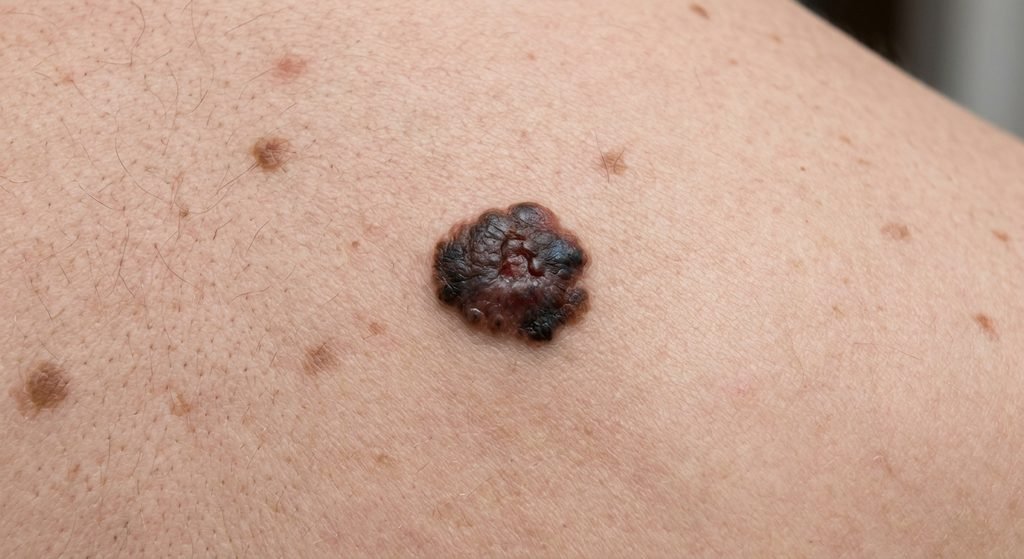
Most people picture melanoma as a flat, irregular mole, but nodular melanoma look alike cases are actually the ones most often mistaken for blood blisters. This subtype grows vertically rather than spreading outward, so it tends to appear as a firm, raised, dome-shaped bump that can be red, black, pink, or even skin-colored. Because it does not always fit the classic ABCDE picture, especially the color and border rules, nodular melanoma is considered one of the more dangerous forms, simply because it gets mistaken for a bruise or blister for longer than it should. A raised, firm bump that keeps growing steadily over several weeks, rather than fading like a normal injury would, is the detail that should prompt a dermatology visit.
Black Spot Under Fingernail: Melanoma or Blood Blister
A black spot under fingernail melanoma or blood blister question comes up constantly, largely because both a subungual hematoma, which is simply bleeding under the nail, and subungual melanoma can look almost identical at first. The clearest distinguishing clue is movement. A blood blister under the nail was almost always caused by an injury you remember, and it slowly migrates toward the tip of the nail as new nail grows in behind it. A resource from Healthgrades explains that subungual hematoma is usually associated with trauma and looks more like a smudge, while melanoma of the nail typically starts as a black or brown band running the length of the nail and is not usually linked to any injury at all. If the dark band stays fixed near the nail base instead of growing out, or if it starts to spread into the surrounding skin of the fingertip (something dermatologists call Hutchinson’s sign), that combination is considered a red flag worth getting checked quickly.
Does a Melanoma Scratch Off
This is a question worth addressing directly because it trips up a lot of people. A blood blister, once it has dried out or scabbed slightly, might flake or peel a little at the surface, giving the false impression that you could scratch the whole thing away. Melanoma does not work that way. It is not sitting on top of the skin like a scab; it has grown from cells within the skin itself, so there is nothing to physically scratch off. If a dark spot seems to be flaking on its surface but the underlying discoloration remains exactly where it was, that is not reassuring evidence of a harmless blister. It simply means the top layer of skin is shedding while the pigmented cells underneath stay put.
Blood Spot Under Skin With No Injury
One of the more unsettling situations is noticing a blood spot under skin no injury involved at all, meaning you genuinely cannot recall bumping, pinching, or rubbing that area recently. While minor injuries can sometimes go unnoticed, especially on the feet or back where you cannot easily see the skin, a spot with no clear trauma history deserves more scrutiny than a spot you know came from slamming a car door. This is also where thrombosed hemangioma vs melanoma comparisons come into play, since a thrombosed hemangioma is a benign blood vessel growth that has clotted internally, creating a firm, dark, sometimes painful lump that can look remarkably similar to both a blood blister and a nodular melanoma on the surface. Because these three conditions can be genuinely difficult to distinguish by eye alone, a lesion appearing without any injury story behind it is one of the clearer signals to get a professional opinion rather than guessing.
Do’s and Don’ts When You Spot a Suspicious Mark
| Do’s | Don’ts |
|---|---|
| Track the date you first noticed it | Don’t assume every dark spot is “just a bruise” |
| Take a photo weekly to monitor changes | Don’t pick at it or try to drain it yourself |
| Note whether you recall any injury | Don’t ignore a spot that grows past two weeks |
| See a dermatologist if it doesn’t fade | Don’t rely on internet photos alone for diagnosis |
| Mention family history of skin cancer | Don’t delay care out of fear of a bad result |
| Protect the area from further friction | Don’t cover it with makeup to “wait and see” longer |
Blood Blister That Won’t Heal: When to Get Concerned
A blood blister that won’t heal within the expected two to three week window is one of the most practical warning signs available, and it deserves to be taken seriously rather than brushed off. Genuine blood blisters follow a fairly predictable healing arc: darkening briefly, then gradually lightening as the trapped blood is reabsorbed by the body. If a spot you assumed was a blister is instead staying the same size, getting darker, developing new colors, or starting to feel firm and fixed to the skin underneath rather than soft and fluid-filled, those are all signs that it may not be a blister at all. At that point, waiting longer does not offer any real benefit, and a dermatology visit is the more sensible next step.
How Dermatologists Tell the Difference: Dermatoscopy
For cases that are genuinely hard to call by eye, dermatologists use a handheld magnifying tool with polarized light called a dermatoscope, and dermatoscopy of blood blister vs melanoma comparisons is where the real diagnostic clarity happens. Under this magnification, a blood blister typically shows a “lacune” pattern, which looks like small, well-defined, reddish-blue pools of trapped blood in a fairly organized arrangement. Melanoma, by contrast, tends to show a chaotic, irregular pigment network that does not follow that neat pooling pattern. This non-invasive exam often reassures both doctor and patient, though if there is still uncertainty, a small skin biopsy remains the definitive way to confirm or rule out melanoma.
Advantages and Disadvantages of Different Diagnostic Approaches
| Diagnostic Method | Advantages | Disadvantages |
|---|---|---|
| Self-monitoring at home | Free, easy, catches obvious changes early | Not reliable for close calls, no magnification |
| Dermatoscopy exam | Non-invasive, fast, highly informative | Requires an in-person dermatologist visit |
| Skin biopsy | Definitive diagnosis, removes all doubt | Minor procedure, results take a few days |
| Waiting to see if it fades | No cost, appropriate for clear trauma cases | Risky if the spot is actually melanoma |
Risk Factors Worth Knowing About
Certain factors raise the likelihood that a suspicious spot is worth extra caution, even before you get to the ABCDE checklist. A personal or family history of melanoma, fair skin that burns easily, a large number of moles, significant past sun exposure, and a weakened immune system all increase overall melanoma risk. Melanoma can also develop in places that rarely see the sun, including the palms, soles of the feet, and underneath the nails, so an unusual location alone is not a reason to dismiss a spot. None of these factors guarantee danger on their own, but they do shift the balance toward getting things checked sooner rather than later.
When to See a Doctor Without Delay
Certain combinations of symptoms should move a decision from “let’s wait and watch” to “let’s book an appointment this week.” These include a spot that has lasted longer than three weeks without fading, one that is growing steadily in size or changing color, a lesion that bleeds or oozes without any trauma to explain it, a dark band under a nail that is not migrating outward with nail growth, or any mark that meets two or more of the ABCDE criteria. Pain is not a reliable reassurance either way, since both conditions can technically present with or without discomfort depending on the individual case. If you are genuinely unsure, a same-week dermatology visit is a far smaller inconvenience than months of uncertainty, and dermatologists see this exact question constantly, so there is no need to feel embarrassed about asking.

Final Thoughts
Most dark spots that show up on the skin really are exactly what they look like: a blood blister from a bump you barely noticed, healing quietly over a week or two without any drama. The handful of cases that turn out to be something more serious tend to share a few common threads, including a lack of trauma history, a spot that keeps changing rather than fading, irregular color or shape, and a timeline that stretches past what a normal injury should take to heal. Learning the ABCDE criteria and watching how a spot evolves over the following weeks gives you a genuinely useful framework, without needing to panic over every bruise. When something still does not add up after a couple of weeks, a quick dermatology visit and a simple dermatoscopy exam will settle the question far better than any amount of searching online ever could.
For further reading on distinguishing these two conditions, Medical News Today’s overview of blood blister vs melanoma and Healthgrades’ guide comparing the two conditions are both well-sourced, medically reviewed resources worth reading in full.