


Digital Eye Strain and Screen Habits are becoming a part of everyday life for millions of people. From checking notifications first thing in the morning to working on a laptop all day and scrolling through social media at night, our eyes spend more time on screens than ever before. While this routine may seem harmless, it can gradually lead to digital eye strain, also known as computer vision syndrome.
The problem is far more common than most people realize. A comprehensive literature review published in 2025 found that digital eye strain affects around 69% of people, with rates varying across different regions, occupations, and age groups. The review also noted that the rise of remote work and online learning during and after the pandemic pushed these numbers even higher, with some studies reporting symptoms in up to 74% of participants.

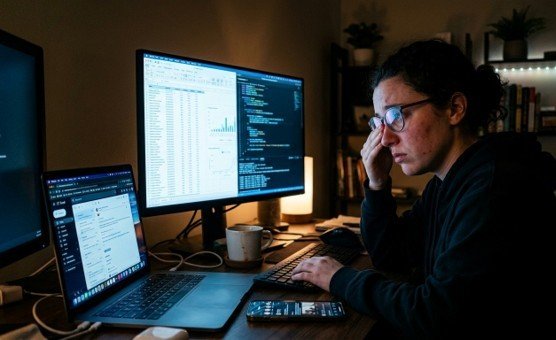
The trend has continued in recent years. A 2026 workplace ergonomics report identified digital eye strain and unhealthy screen habits as one of the fastest-growing occupational health concerns. Longer working hours, hybrid jobs, and the use of multiple screens have made eye fatigue, dryness, blurred vision, and headaches increasingly common. Clinical research suggests that between 50% and 66% of digital device users experience these symptoms, meaning many people may be living with digital eye strain without realizing what’s causing their discomfort.
What Is Digital Eye Strain?
Digital eye strain, medically referred to as computer vision syndrome (CVS), describes a group of eye and vision problems that appear after spending long, uninterrupted periods looking at screens — computers, phones, tablets, and even television. It is not a single disease but rather a cluster of symptoms that build up gradually, often without the person noticing until the discomfort becomes hard to ignore.
The condition sits at the intersection of eye physiology and everyday behavior. Screens demand a type of sustained near-focus that human eyes were never really designed for over such long stretches. According to EyeWiki, a reference resource maintained by ophthalmology professionals, there is no evidence that screen light physically damages the eyes, but the visual and muscular fatigue caused by extended near-work is very real and well documented.
How Common Is Digital Eye Strain Today?
The scale of this issue is larger than most people assume. A comprehensive literature review published in 2025 found that computer vision syndrome affects roughly 69 percent of the population, with rates shifting depending on gender, region, and occupation. The same review noted that the shift toward remote work and online learning during and after the pandemic pushed symptom rates even higher, with some studies reporting discomfort in up to 74 percent of participants.
A separate 2026 workplace ergonomics report described digital eye strain as one of the fastest-growing occupational health concerns of the year, pointing out that hybrid work schedules and multi-screen setups are stretching daily screen exposure well past what was normal even five years ago. Some clinical sources place the global range between 50 and 66 percent of device users, which still means that more than half of everyone reading this article on a screen right now is a likely candidate.
Common Symptoms of Digital Eye Strain
Digital Eye Strain and Screen Habits have become a growing concern in today’s digital world, yet many people don’t realize just how common the problem is. Whether you’re working from home, attending online classes, or simply scrolling through your phone, spending long hours in front of screens can take a toll on your eyes. A comprehensive literature review published in 2025 found that digital eye strain, also known as computer vision syndrome, affects around 69% of people. The study also revealed that the shift to remote work and online learning during and after the pandemic increased symptoms even further, with some research reporting eye discomfort in up to 74% of participants.
The trend has continued in recent years. A 2026 workplace ergonomics report described digital eye strain and poor screen habits as one of the fastest-growing occupational health concerns. Hybrid work, longer screen hours, and the use of multiple devices have made eye fatigue more common than ever. Clinical research estimates that between 50% and 66% of digital device users experience symptoms, which means there’s a good chance that many people reading this article have already dealt with tired, dry, or strained eyes without realizing what caused them.
Vision Problems
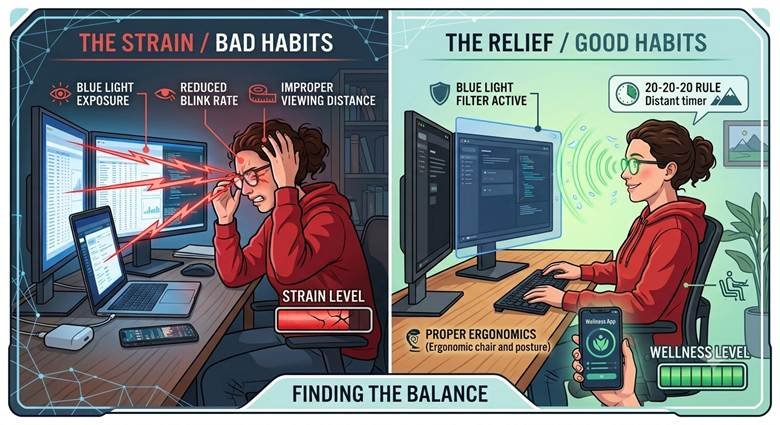
Reduced blink rate is one of the biggest contributors. Under normal conditions, people blink around 15 to 20 times per minute, but that number drops significantly while focusing on a screen, which reduces tear film distribution and leads to dryness. Screen glare and poor contrast also force the eyes to work harder to distinguish text and images, since digital screens present visual information differently than printed material or natural light. Poor lighting and incorrect viewing distance add further strain, especially when a screen is too close, too bright, or positioned at an awkward angle relative to natural window light.
Research published through Nature’s research intelligence summaries points out that prolonged digital use can disrupt binocular visual functions, particularly the eye’s ability to focus and converge properly, which reinforces why screen-related strain is now considered a genuine functional issue rather than just tiredness.
Uncorrected vision problems are another underlying factor that often goes unnoticed. People with mild farsightedness, astigmatism, or an outdated prescription tend to compensate by squinting or leaning closer to the screen, both of which increase muscular fatigue around the eyes. Text size and font clarity matter too — small, low-contrast text forces the eyes to work harder to decode letters, especially on smaller phone screens viewed in bright outdoor light. Even something as simple as low humidity in air-conditioned offices can dry out the tear film faster, compounding the dryness already caused by a reduced blink rate. None of these factors act alone; it is usually the overlap of several small issues that turns a manageable amount of screen time into a genuinely uncomfortable one.

Screen Habits That Make Eye Strain Worse
Beyond the biology, everyday habits play a massive role in how severe digital eye strain becomes. A UK and Ireland based study of working adults found that the average person used digital devices for 9.7 hours a day, and that digital eye strain occurred in 62.6 percent of participants, with musculoskeletal symptoms reported by an overwhelming 94.3 percent of users.
Certain habits consistently show up as major contributors: working without breaks for hours at a stretch, using phones in dim or dark rooms right before sleep, keeping brightness settings too high or too low for the surrounding environment, and multitasking across several screens at once. These patterns do not just add up individually — they tend to compound each other, turning a mild end-of-day tiredness into a chronic daily complaint.
The 20-20-20 Rule and Other Proven Relief Methods
Eye care professionals widely recommend the 20-20-20 rule as the simplest and most effective habit for reducing digital eye strain. The idea is straightforward: every 20 minutes, look at something at least 20 feet away for a full 20 seconds. This brief pause allows the eye’s focusing muscles to relax and helps restore a more natural blink rate.
Despite being the most recommended strategy by professionals, adoption remains surprisingly low. Only about 20 percent of adults consistently follow the 20-20-20 rule, based on data shared in this digital eye strain prevalence report. Other proven relief methods include adjusting screen brightness to match room lighting, using artificial tears for dryness, positioning screens slightly below eye level, and scheduling regular full breaks away from all screens, not just a switch from one device to another.
Do’s and Don’ts for Healthy Screen Habits
| Do’s | Don’ts | ||
| Follow the 20-20-20 rule during work sessions | Stare at a screen for hours without any break | ||
| Adjust screen brightness to match room lighting | Use a screen at full brightness in a dark room | ||
| Blink consciously and use artificial tears if needed | Ignore persistent dryness or redness in the eyes | ||
| Position your screen about an arm’s length away | Sit too close to your monitor or phone screen | ||
| Get an eye check-up at least once a year | Assume eye strain will simply go away on its own | ||
| Use anti-glare settings or screen filters | Work directly under harsh overhead lighting | ||
| Take a real break away from all screens | Replace a work screen break with a phone scroll break | ||
Digital Eye Strain Across Different Groups
Digital eye strain does not affect everyone equally. Age, occupation, and screen habits change both the risk and the severity of symptoms. University students report some of the highest prevalence rates of any group, largely due to long study hours combined with heavy smartphone use outside of academics, it is also noticed that women report higher rates of CVS than men across most regions studied.
Remote and hybrid workers form another high-risk group, given the extended hours already discussed in the UK and Ireland study referenced earlier. Meanwhile, ophthalmology sources have raised growing concern about children, noting that progressive myopia is an emerging issue particularly among kids who spend four or more hours a day on screens.
| Group | Reported Prevalence | Key Contributing Factor |
| General adult population | ~69% | Overall increase in daily screen hours |
| University students | 66–75%+ | Long study sessions plus heavy phone use |
| Remote/hybrid workers | ~62.6% | Average 9.7 hours of daily device use |
| Children (4+ hours/day) | Rising concern | Progressive myopia risk in early years |
Long-Term Risks of Ignoring Digital Eye Strain
Most cases of digital eye strain are not permanent and improve once habits change but ignoring the symptoms over long periods can carry real costs. Beyond the discomfort itself, there is a measurable economic impact. Recent 2026 data indicate that digital eye strain contributes to more than 2 billion dollars in annual workplace productivity losses, with affected employees reporting around 15 percent lower efficiency during the final two hours of their shift.
For children and teenagers, unmanaged screen exposure is being linked to a rising trend in myopia, which is a concern that eye care providers are watching closely as device use starts earlier in life. For adults, chronic untreated strain can spill over into disrupted sleep, since blue light exposure late at night interferes with the body’s natural signal to wind down, and constant squinting or poor posture while viewing screens can also contribute to lasting tension headaches and neck stiffness that go well beyond the eyes themselves.
There is also a quieter, cumulative cost that rarely gets discussed: the way persistent low-grade discomfort chips away at focus and mood over an entire day. People experiencing ongoing eye strain often report finding it harder to concentrate on tasks, feeling more irritable by late afternoon, and reaching for caffeine or short screen breaks that do not actually address the root problem. Over months and years, this pattern can normalize a level of discomfort that would otherwise be a clear signal to make changes. Recognizing digital eye strain early, rather than dismissing it as ordinary tiredness, is one of the simplest ways to prevent it from becoming a long-standing part of daily life.
A Simple Daily Checklist for Healthier Screen Habits
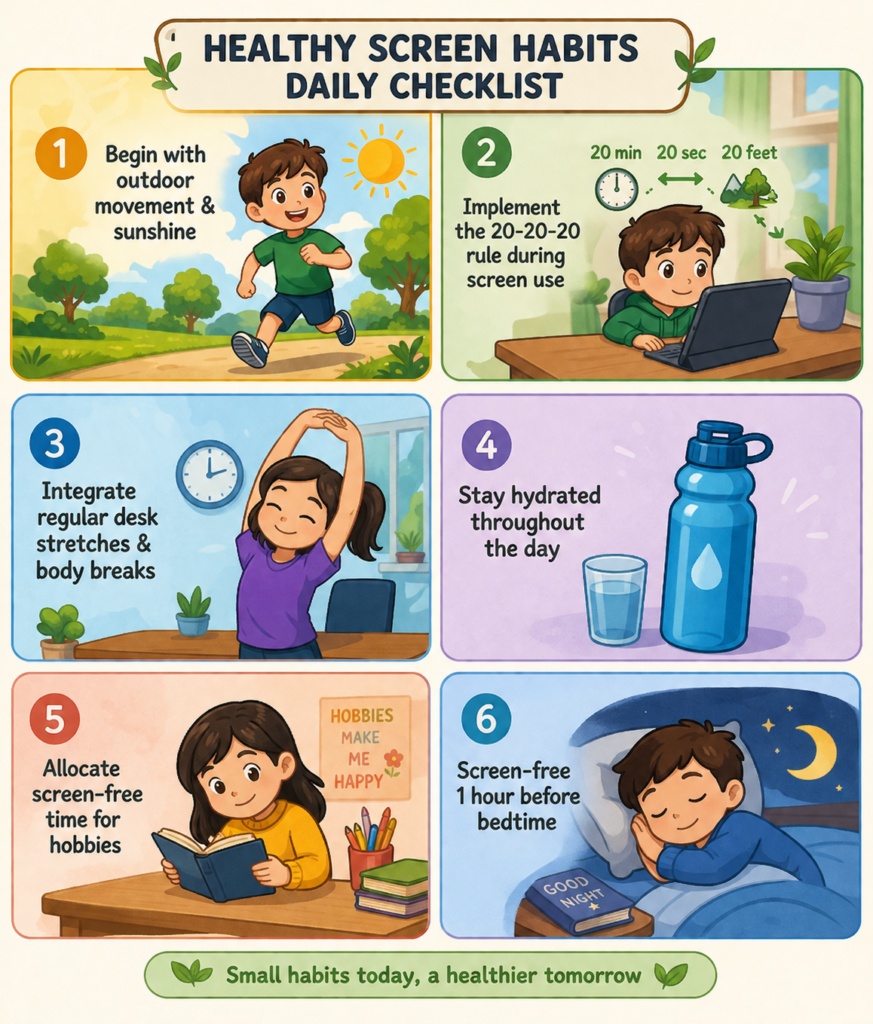
Small, consistent adjustments tend to work far better than occasional major changes. Below is a simple daily checklist that reflects the habits most consistently recommended by eye care professionals and supported by current research.
| Time of Day | Habit to Practice |
| Morning | Set screen brightness to match natural daylight |
| Every 20 minutes | Look 20 feet away for 20 seconds |
| Every 2 hours | Stand up and take a 5–10 minute screen-free break |
| Midday | Check posture and screen distance/angle |
| Evening | Reduce screen brightness as natural light fades |
| 1 hour before bed | Switch off screens or enable a strong night mode |
| Once a year | Schedule a comprehensive eye examination |

Final Thoughts
Digital eye strain is very much a condition of our time, shaped as much by daily habits as by the devices themselves. The encouraging part is that it is largely preventable and manageable once the right habits are in place. Small changes — taking real breaks, adjusting lighting, blinking more consciously, and giving your eyes a genuine rest from all screens rather than switching between them — can make a measurable difference over time.
Screens are not going anywhere, and there is no need to see them as the enemy. The goal is simply to use them a little more mindfully, so your eyes can keep up with the pace of everything else in your day.