


What Are the Pros and Cons of Same-Day vs. Traditional Dental Implants?
Few dental decisions feel as big as replacing missing teeth. You are not just choosing a procedure; you are choosing how you will eat, speak, and smile for the next twenty years or more. Over the last decade, same-day dental implants have grabbed attention with a bold promise: walk in with a gap or failing teeth and walk out with a full, functioning smile in a single visit. It sounds almost too good to be true, and that is exactly why so many patients are left confused. Is the faster route as reliable as the slower, traditional path? Who qualifies, what does it cost, and what might go wrong? This article compares same-day dental implants vs traditional implants in plain language, so you can talk to your dentist with confidence and choose the option that genuinely fits your mouth, your health, and your budget.

Understanding the Basics of Both Approaches
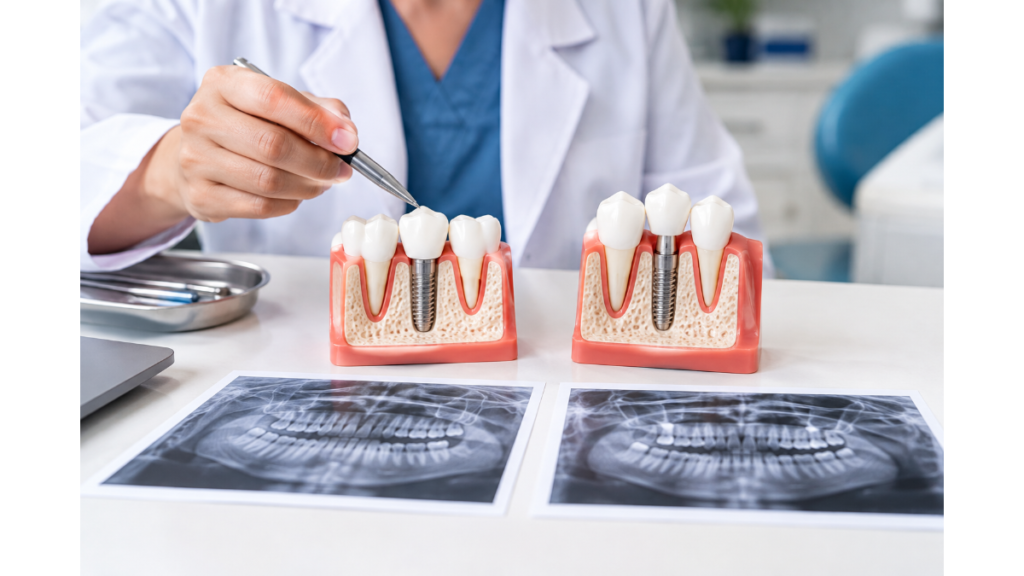
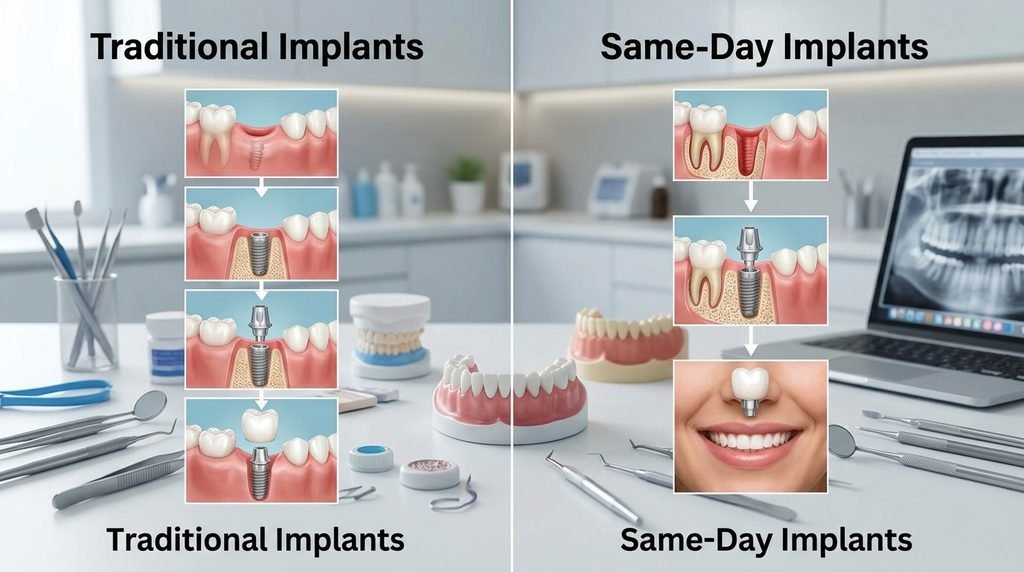
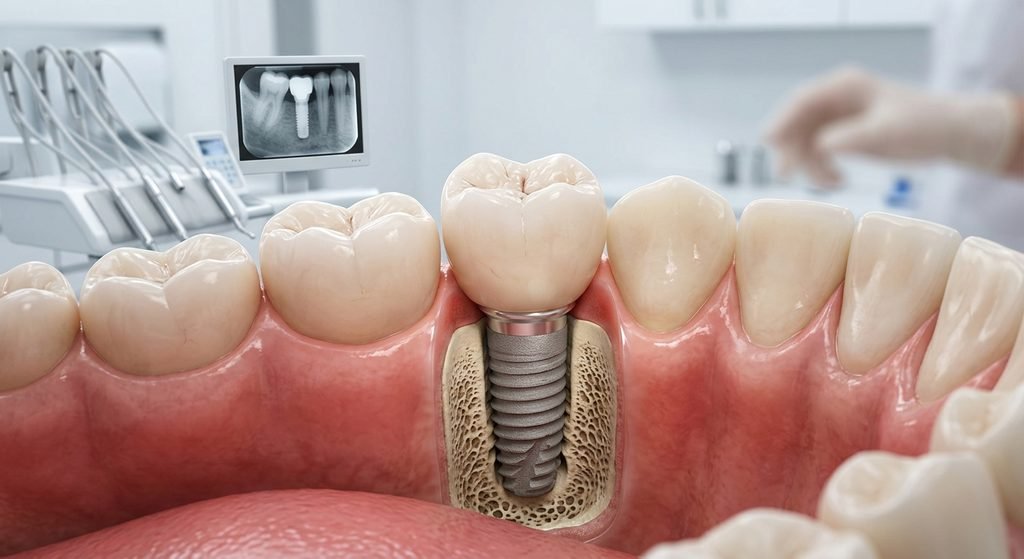
Before comparing them, it helps to know what each approach actually involves. A dental implant is a small titanium or ceramic post that is placed into the jawbone to act as an artificial tooth root. A crown, bridge, or denture is then attached to it. In the traditional approach, the implant is placed first, and the gum and bone are given several months to heal before the final tooth is attached. In the same-day approach, the implant is placed and a temporary tooth is attached on the very same day, which is why you will hear it called immediate load dental implants or “teeth in a day.” Both methods use the same basic hardware. The real difference lies in timing, planning, and how much stress the new implant is allowed to carry while it heals.
How Same-Day Dental Implants Work
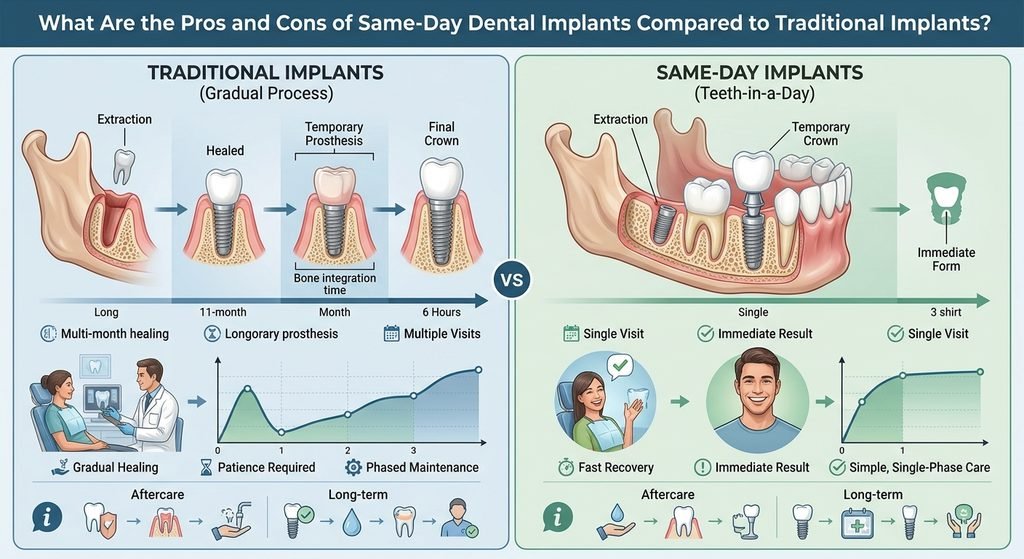
Same-day dental implants depend heavily on careful digital planning. Your dentist will usually take 3D scans of your jaw before the surgery date, map out the ideal implant positions, and sometimes use a surgical guide to place them with great precision. On the day of treatment, any damaged teeth are removed if needed, the implants are placed, and a temporary set of teeth is fixed on top, often within a few hours. These temporary teeth look natural and let you eat soft foods, but they are not the final restoration. Several months later, once the bone has healed, you return to receive the permanent crowns or bridge. So the term “same-day” really refers to getting teeth the same day, not finishing the entire treatment in one visit.
The Traditional Dental Implant Procedure Explained
The traditional method is slower but more conservative. After an initial consultation and imaging, the implant is placed in the jawbone and the gum is often closed over it, allowing it to heal without any chewing pressure. During this healing period, you may wear a temporary denture or simply live with a gap. Once healing is complete, a small second procedure exposes the implant, and an abutment and final crown are attached. This step-by-step process has the longest track record in dentistry and is considered very predictable. Its main drawback is patience, because you may spend many months waiting before you can enjoy your final teeth.
Traditional Dental Implant Procedure Duration
Many patients ask how long the traditional route really takes, and the honest answer is that it varies. The traditional dental implant procedure duration commonly ranges from three to six months from implant placement to the final crown, and it can stretch to nine months or longer if extractions, bone grafts, or sinus procedures are needed. Add the planning appointments and follow-ups, and the whole journey can feel long. Same-day implants shorten the time you spend without teeth, but the full healing process still takes about the same amount of time behind the scenes. The speed is in the appearance and function early on, not in the biology of healing.
Osseointegration and Healing Time
The key to any implant’s long-term success is a process called osseointegration, in which the jawbone grows around the implant and locks it firmly in place. Osseointegration healing time usually takes between three and six months, depending on bone quality, the implant location, and your general health. Lower jaw bone is often denser and heals faster, while the upper jaw may take longer. This is the heart of the debate. With traditional implants, the implant is left undisturbed during this period. With immediate load dental implants, the implant carries a temporary tooth from day one, so it must be stable enough at placement to handle that early stress without moving. If it moves too much, osseointegration can fail.
Pros of Same-Day Dental Implants
The biggest advantage is obvious: you do not have to live without teeth. For someone who is self-conscious about missing front teeth or struggling with failing dentures, leaving with a finished-looking smile can be life-changing. Fewer surgical appointments often mean less time off work and less overall disruption. Many patients also appreciate that same-day treatment can preserve the shape of the gums and the facial structure, since the temporary teeth support the soft tissue right away. Another benefit is that extraction and implant placement can happen together, which reduces the number of separate procedures. For the right patient, these single-day tooth replacement options offer comfort, convenience, and a real boost in confidence.
Cons of Same-Day Dental Implants
The speed does come with trade-offs. Not everyone has enough healthy bone or a stable enough jaw for an implant to take a load immediately. Some patients may still need a bone graft, which can delay or rule out same-day treatment. Because the implant is under pressure from the start, there is a slightly higher risk of early failure if the patient bites too hard or does not follow the soft-food diet. The treatment also requires an experienced dental team and advanced technology, which can raise costs. Finally, the temporary teeth are not designed to last, so you will need a second phase of treatment later. It is faster to start, but it is not necessarily faster to finish.
Pros and Cons at a Glance
Here is a simple side-by-side view of the main points, to help you weigh the choices without wading through every detail.
| Factor | Same-Day Implants | Traditional Implants |
|---|---|---|
| Time to get teeth | Same day (temporary) | Several months |
| Number of surgeries | Often fewer | Usually two stages |
| Healing risk | Slightly higher if bone is weak | Lower, as implants are not loaded early |
| Bone requirements | Needs good bone density | More flexible, with grafting options |
| Appearance during healing | Immediate teeth | Gap or temporary denture |
| Long-term track record | Strong, but newer | Longest history of success |

Dental Implant Success Rates
Patients naturally want to know how reliable these treatments are. Dental implant success rates are high across the board, with many studies showing figures of around 90 to 98 percent over ten years for well-placed implants in healthy patients. Traditional implants have the longest research history and tend to show the most consistent results. Immediate load dental implants also perform very well when patients are carefully selected and the implants are placed securely. The difference is that same-day treatment leaves less room for error. Smoking, uncontrolled diabetes, gum disease, and poor oral hygiene reduce success rates for both methods, so the patient’s health and habits matter just as much as the technique.
Same-Day Dental Implant Candidacy
Not everyone is a good candidate, and a trustworthy dentist will tell you so. Same-day dental implant candidacy usually requires enough healthy jawbone, healthy gums, good general health, and a bite that can handle temporary teeth without excessive force. People who grind their teeth heavily, smoke, have uncontrolled diabetes, or have untreated infections in the mouth may be advised to choose the traditional route. Age alone is rarely a barrier, but bone quality is. A 3D scan and a thorough clinical exam are the only reliable ways to find out. If a clinic promises same-day teeth without examining your bone first, treat that as a warning sign and seek another opinion.
Dental Implant Bone Graft Requirements
Bone grafting deserves its own discussion because it often decides which path is possible. Dental implant bone graft requirements arise when the jawbone is too thin or too soft to hold an implant firmly, which commonly happens after long-term tooth loss, gum disease, or wearing dentures for many years. In a traditional approach, a graft can be placed and allowed to heal for several months before the implant goes in, which gives the dentist more control. Some same-day cases can include minor grafting at the time of surgery, but extensive grafting usually pushes treatment toward the traditional timeline. Do not be discouraged if you are told you need a graft. It simply builds a stronger foundation for a result that lasts.
Cost of Same-Day Teeth
Money matters, and this is where many patients feel the most uncertainty. The cost of same-day teeth is usually higher than a basic traditional single implant, because it involves advanced imaging, surgical guides, and a temporary set of teeth in addition to the final restoration. Prices vary widely depending on your location, the number of implants, the materials used, and the clinic’s experience. For a full arch, costs can run into the tens of thousands of dollars, and a single implant is also a significant investment. Remember that you may pay for two sets of teeth, temporary and permanent. Ask for a detailed written quote, find out what insurance may cover, and compare financing options before deciding.
Which One Is Better for Different Situations?
There is no universal winner, which is why searching for the best dental implant options can be frustrating. The right choice depends on your situation. The table below offers a practical guide, though only your dentist can give a personal answer.
| Your Situation | Likely Better Option | Reason |
|---|---|---|
| Strong, healthy jawbone and good oral health | Same-day implants | Stable enough for immediate loading |
| Thin or weak bone needing grafts | Traditional implants | Allows time for bone to rebuild |
| Visible front tooth missing, need quick appearance | Same-day implants | Immediate cosmetic benefit |
| Heavy teeth grinding or smoking | Traditional implants | Lower early failure risk |
| Tight budget and flexible timeline | Traditional implants | Often lower upfront cost |
| Full-arch replacement with failing teeth | Either, depending on bone | Many choose same-day for convenience |
Recovery and Aftercare
Recovery looks a little different for each approach, but both need care. After same-day surgery, you will usually be asked to stick to soft foods for several weeks, avoid biting hard on the temporary teeth, and keep the area very clean. Mild swelling, bruising, and tenderness are normal for a few days and can generally be managed with prescribed medicines and cold compresses. Traditional implants have a gentler early recovery since there is no chewing pressure, but you still need to look after the site and attend follow-ups. For either approach, regular dental visits and excellent brushing and flossing are essential to prevent infections around the implant, which is the biggest threat to its long-term life.
Questions to Ask Your Dentist
A good consultation should feel like a conversation, not a sales pitch. Ask how many same-day cases the dentist or surgeon has completed, what the success and complication rates are, and what happens if an implant does not integrate. Ask to see before-and-after photos of real patients, and request a clear explanation of why one approach suits you better than the other. It is also worth asking what materials will be used, who will do the surgery, and how follow-up care is handled. If you want trustworthy background information before your appointment, the American Academy of Implant Dentistry and the American Dental Association’s MouthHealthy site both offer patient-friendly guides.
Final Thoughts: Making the Right Choice for You
Same-day dental implants are a remarkable advance, and for the right patient they offer speed, comfort, and confidence that traditional methods cannot match. Traditional implants, on the other hand, remain the gold standard for predictability, especially when bone quality is uncertain or extra healing time is wise. Neither option is automatically better. The right choice comes down to your bone health, your habits, your budget, and how soon you need to see results. Take your time, get a thorough scan and examination, and do not be afraid to seek a second opinion. A well-planned implant, whichever route you choose, can serve you for decades, and the best decision is always the one made with good information and a dentist you trust.