


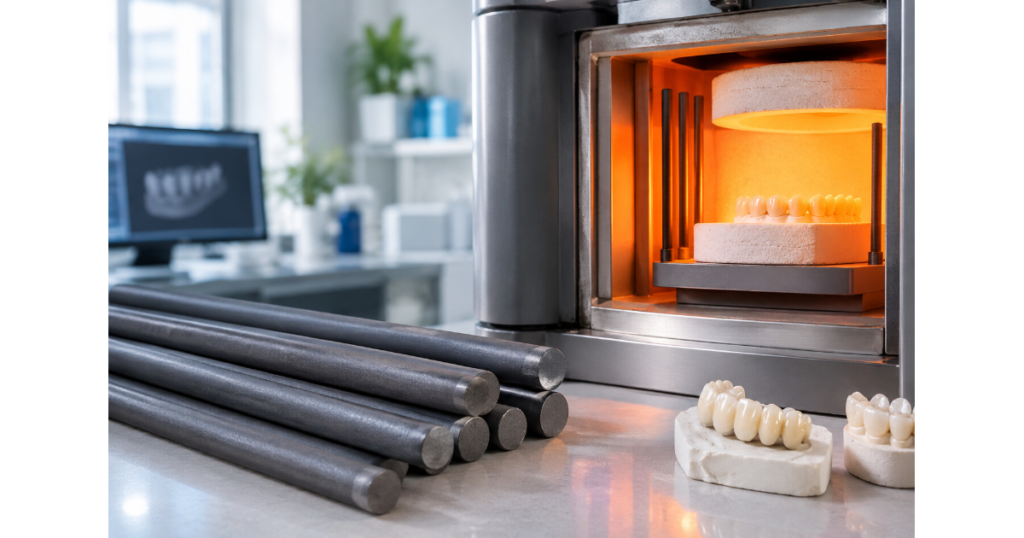
What Makes MoSi₂ the Right Material for Dental Furnaces?
Walk into any modern dental lab and you will find a machine that quietly decides whether a crown is a success or a remake: the furnace. Inside it, a ceramic blank goes through hours of intense heat and comes out as a hard, precise, natural-looking restoration. At the center of the best-performing machines sits a heating element made from molybdenum disilicate, better known as Mosi₂. It is not the only option, but for a dental furnace that has to run at high-temperature settings day after day without drifting or failing, it is very hard to beat. This article explains why, in plain language, and what technicians and lab owners should know before choosing or maintaining these elements.

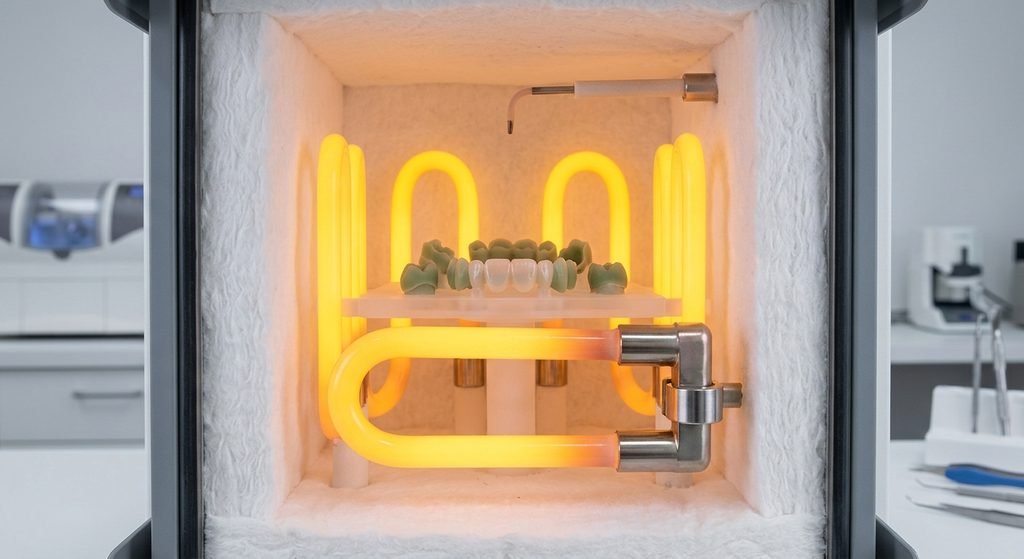
Why the Heating Element Matters More Than You Think
Most people judging a dental furnace look at the control panel, the chamber size, or the price. The heating element gets far less attention, yet it determines almost everything about how the furnace behaves. It sets how high the temperature can go, how evenly heat spreads through the chamber, how fast the cycle can run, and how long the machine will last before it needs costly repairs.
Think of it like the engine in a car. You can have a beautiful body and a clever dashboard, but if the engine struggles, the whole experience suffers. In dental work, a poorly performing element can show up as uneven shading, warped frameworks, or restorations that fail a fit check. Because the stakes are that practical, understanding the material behind the heat is worth the effort.
Understanding MoSi₂ in Simple Terms
Molybdenum disilicide is an intermetallic compound made of molybdenum and silicon. It sits somewhere between a metal and a ceramic, and it borrows useful traits from both. Like a metal, it conducts electricity well enough to heat up when current passes through it. Like a ceramic, it tolerates extreme heat and resists chemical attack. It has been used for decades in laboratory and industrial furnaces, and general background on the compound is available on Wikipedia’s page on molybdenum disilicide.
What makes it special for dentistry is that these properties arrive together. Many materials handle heat but crack under stress, or conduct well but oxidize quickly. MoSi₂ manages a balance that suits the repeating, demanding cycles of dental sintering.
The Self-Healing Oxidation That Protects the Element
The most impressive feature of MoSi₂ is its self-healing oxidation behavior. When the element is heated in air, the silicon at its surface reacts with oxygen and forms a thin, glassy SiO₂ layer, which is essentially quartz glass. This layer is dense and sticks tightly to the element, and it seals the surface so oxygen cannot reach the material underneath.
The self-healing part is the clever bit. If a tiny crack or flaw appears in that protective skin, fresh silicon from the interior is exposed to oxygen and immediately forms new silica to fill the gap. The element essentially repairs its own armor while it works. Most heating materials cannot do this. They oxidize steadily, lose material, and thin out until they fail.
For a busy lab, this matters a great deal. The SiO₂ layer means the element does not slowly waste away during normal operation, which keeps its resistance stable and its output predictable over a long working life. It is one of the main reasons MoSi₂ has earned trust in high-temperature applications where air is always present.
Reaching the Temperatures Zirconia Demands
Zirconia sintering is the process that turns a soft, chalky, milled zirconia blank into a dense, strong restoration. It typically calls for temperatures in the range of roughly 1,450°C to 1,600°C, depending on the material and the manufacturer’s recommendations. That is a serious amount of heat, and it must be held with precision.
MoSi₂ elements can operate at element surface temperatures well above this range, with commercial grades rated up to around 1,800°C. That gives a dental furnace comfortable headroom. The element is not being pushed to its limit just to reach sintering temperature, and that reserve improves reliability and lifespan. Silicon carbide elements, a common alternative, generally struggle to hold the upper end of the zirconia range consistently in air, which is one reason MoSi₂ became the preferred choice for zirconia work.
For labs that also handle newer high-translucency or multilayer zirconia, which can require tighter temperature control and sometimes slightly different peak settings, that headroom becomes even more valuable.
Uniform Heating and Why It Protects Your Restorations
A restoration sinters best when every part of it experiences the same thermal history. If one side of the chamber runs hotter than the other, the zirconia shrinks unevenly. Zirconia typically shrinks by around twenty percent during sintering, so even small differences in heat can lead to distortion, poor marginal fit, or internal stress.
Uniform heating is one of the quiet strengths of a well-designed MoSi₂ furnace. The elements radiate heat efficiently and can be arranged around the chamber so that the temperature field stays even. Because the material’s behavior is stable and predictable at high temperature, the furnace controller can regulate output smoothly without constant correction.
In practical terms, this shows up in results. Long-span bridges hold their shape, margins seat cleanly, and technicians spend less time adjusting restorations at the bench. Consistency between the first unit in a batch and the last is the real measure of a good furnace, and stable heating is what delivers it.
Thermal Shock Resistance in Everyday Use
Dental labs do not run their furnaces in a gentle, textbook fashion. Cycles start and stop, doors open, and modern speed-sintering programs push temperatures up and down quickly. That puts a lot of stress on heating elements, and thermal shock resistance becomes essential.
MoSi₂ handles rapid heating and cooling far better than many competing materials. At high temperatures, it becomes ductile and can flex slightly rather than crack, which helps it survive fast ramps. Silicon carbide, by comparison, tends to age faster under repeated fast cycling because its resistance rises over time and it grows more brittle.
That said, it is worth being honest about one weakness. MoSi₂ is brittle at room temperature, so elements must be handled carefully during installation and never struck or bent. Once hot, they become far more forgiving. Understanding this pattern helps technicians treat the elements properly and avoid preventable damage.
Electrical Conductivity and Efficient Power Use
A heating element has to convert electricity into heat reliably, and this is where electrical conductivity enters the picture. MoSi₂ conducts well enough to heat efficiently, yet has enough resistance to generate significant warmth. Its resistance also rises with temperature, which acts as a natural stabilizer: as the element gets hotter, it draws slightly less current, which helps prevent runaway heating.
This predictable behavior simplifies the furnace’s power control. The system can deliver steady, repeatable output, which supports accurate temperature profiles cycle after cycle. It also means the furnace tends to use energy sensibly, an increasingly important consideration as lab owners watch operating costs.
Because the resistance of MoSi₂ is low when cold and climbs as it heats, these furnaces usually need appropriate transformers or power controllers to manage the initial current. Manufacturers design for this, so it is a feature of the system rather than a flaw.
Structural Durability Over Years of Service
Lab owners think in terms of return on investment, and structural durability is a big part of that equation. A heating element that survives thousands of cycles without significant degradation keeps downtime and replacement costs low.
Thanks to its protective silica coating, MoSi₂ resists oxidation, corrosion, and erosion from the furnace atmosphere. It does not shed material or thin out the way many alternatives do. With good care, elements can run for years in a typical dental setting, and if one does fail, the modular design of most furnaces allows individual elements to be swapped without rebuilding the machine.
Manufacturers of high-temperature heating elements, such as Kanthal, publish technical guidance on element care, and following those recommendations further extends life. Avoiding excessive dwell at low temperatures and keeping the chamber clean are simple habits that pay off.
Protecting Translucency Preservation
Aesthetics are what patients notice first, and this is where furnace quality quietly shapes clinical results. Modern zirconia is prized for its lifelike appearance, but that appearance depends heavily on sintering conditions. Overheating, uneven heating, or contamination can cloud the material and dull its natural glow.
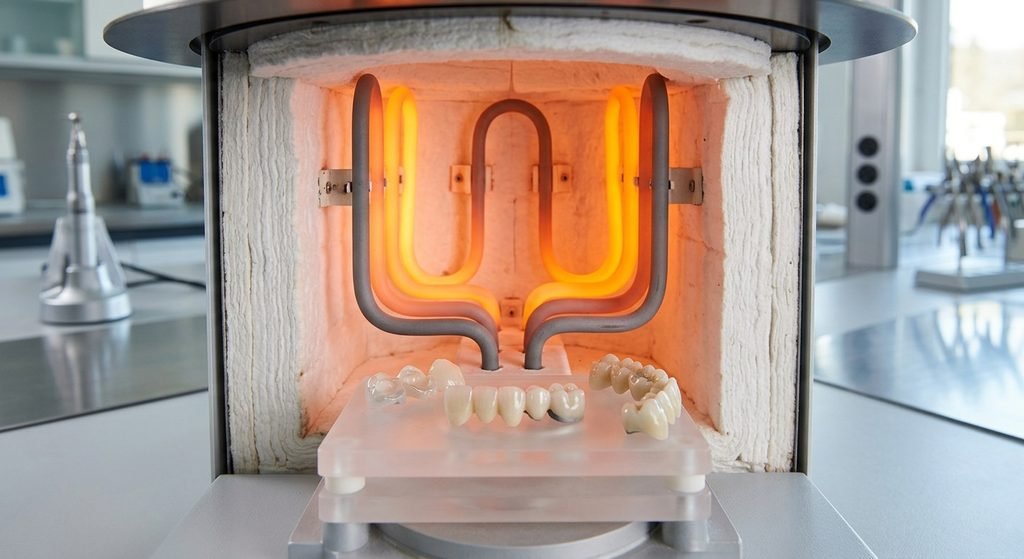
Translucency preservation depends on clean, accurate, repeatable temperature control, and MoSi₂ supports this in two ways. First, its stable heating helps the zirconia reach the correct density and grain structure without overshooting. Second, it produces a clean heating environment. Unlike some elements, MoSi₂ does not release contaminating byproducts that could discolor or affect the restorations inside the chamber.
For anterior crowns and veneers, where a slightly dull or gray result is immediately obvious, this reliability can be the difference between a delighted patient and a remake. Consistent sintering also helps labs match shades more predictably.
Retrofit Compatibility for Existing Labs
Not every lab can afford to buy a brand-new furnace, and this is where retrofit compatibility becomes attractive. Many older furnaces were built around standard element sizes and shapes, and MoSi₂ elements are widely manufactured in common configurations, including U-shaped and W-shaped designs.
That means labs can often upgrade an aging machine with modern MoSi₂ elements to improve temperature capability and reliability without replacing the whole system. Before doing this, it is important to confirm that the furnace’s power supply, insulation, and controller can handle the new elements. A good supplier or technician can check these details, and a properly matched retrofit can breathe years of new life into equipment that would otherwise be retired.
Advantages and Disadvantages at a Glance
No material is perfect, and being clear about trade-offs leads to better decisions. The table below summarizes the main strengths and limitations of MoSi₂ in dental furnace applications.
| Aspect | Advantages | Disadvantages |
|---|---|---|
| Temperature capability | Operates well above zirconia sintering needs, with reliable high-temperature headroom | Performance depends on correct power control at low temperatures |
| Oxidation behavior | Self-healing SiO₂ layer protects the element in air | Protective layer can be affected by prolonged use at very low temperatures |
| Thermal cycling | Strong thermal shock resistance at working temperatures | Brittle at room temperature, so careful handling is required |
| Lifespan | Excellent structural durability with proper care | Higher upfront cost than some alternatives |
| Heating quality | Supports uniform heating and stable output | Needs suitable transformers or controllers |
| Clinical outcomes | Helps with translucency preservation and clean sintering | Results still depend on correct sintering programs |
MoSi₂ Compared With Other Heating Element Options
To understand why MoSi₂ has become the standard for zirconia work, it helps to see it beside its main competitors. The comparison below is a general guide, since exact figures vary by manufacturer and grade.
| Feature | MoSi₂ | Silicon Carbide (SiC) | Metallic Wire (e.g., FeCrAl) |
|---|---|---|---|
| Typical maximum furnace temperature | Up to about 1,700°C | Up to about 1,500–1,600°C | Up to about 1,200–1,300°C |
| Suitability for zirconia sintering | Excellent | Limited at upper range | Not suitable |
| Ageing behavior | Very stable resistance | Resistance rises over time | Gradual oxidation and thinning |
| Rapid cycling tolerance | Very good | Moderate | Moderate |
| Typical service life in dental use | Long | Medium | Short at high temperatures |
| Relative initial cost | Higher | Moderate | Lower |
The pattern is clear. Metallic wire elements are cheap but simply cannot reach the temperatures zirconia needs. Silicon carbide gets closer but ages faster and struggles at the top of the range. MoSi₂ costs more upfront, yet its stability and longevity usually make it the more economical choice over the life of the furnace.
Practical Care Tips for Getting the Most from Your Elements
Even a superb material benefits from good habits. A few simple practices go a long way. Avoid holding the furnace at moderate temperatures, roughly 400°C to 700°C, for long periods, because Mosi₂ can suffer a phenomenon called pestling at those temperatures. Keep the chamber clean so debris does not react with the elements. Follow the manufacturer’s recommended heating rates, especially when using a new or replacement element. When installing new elements, handle them gently and never force them into position.

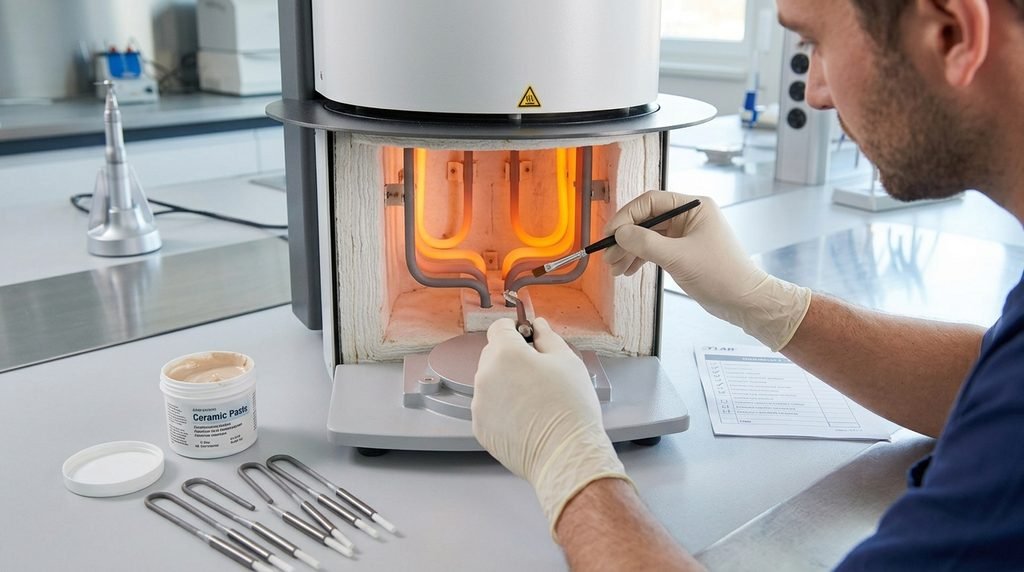
It also pays to replace elements in matched sets rather than mixing very old ones with new ones, since differences in resistance can cause uneven heating. Small routines like these protect both the elements and the restorations they produce.
Looking Ahead: Why MoSi₂ Will Stay Relevant
Dental technology keeps moving. Zirconia formulations are becoming more translucent, sintering cycles are getting faster, and chairside workflows are demanding reliable equipment in smaller spaces. All of these trends put more pressure on the heating element, and MoSi₂ is well positioned to meet them.
Its combination of high-temperature strength, protective oxidation behavior, and predictable electrical performance gives furnace designers a solid platform to build on. As long as zirconia remains the backbone of modern restorative dentistry, it is likely that MoSi₂ will remain the material of choice for the machines that sinter it.
Final Thoughts
So, what makes MoSi₂ the right material for dental furnaces? It comes down to a rare balance. It reaches the temperatures zirconia needs with room to spare, protects itself through a self-healing silica layer, tolerates the stress of fast cycling, and delivers even, clean heat that supports both strength and beauty in the finished restoration. It is durable enough to justify its price, and flexible enough to upgrade many existing furnaces.
For dental labs, the takeaway is simple. When you evaluate a furnace, look past the display and ask about the heating element. A machine built around quality MoSi₂ is an investment in consistency, and consistency is what keeps patients satisfied and remakes rare.