

How Is CAD/CAM Technology Changing the Way Dental Labs Operate?
Walk into a dental laboratory today and the first thing you notice is how quiet it has become. A generation ago, the room would have been full of the smell of acrylic, the hum of polishing motors, and technicians bent over stone models with wax knives. Those skills still matter, but the center of gravity has moved to the screen. Dental CAD CAM technology has reshaped how restorations are designed, produced, and delivered, and it has done so faster than almost anyone predicted. Labs that once measured their output in handcrafted units per week now run digital pipelines that move cases from scan to finished crown with far less guesswork. This change is not just about shiny new machines. It affects how labs hire, how they price their work, how they talk to dentists, and what they promise patients. In this article, we look at what is really happening inside modern labs, what the technology gets right, and where it still asks for patience and investment.
What Dental CAD CAM Technology Actually Means
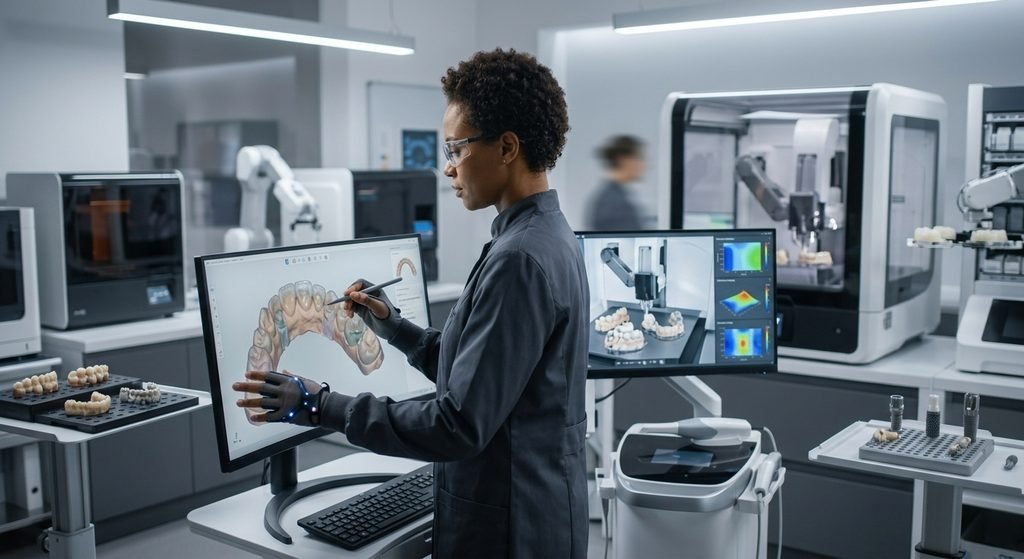
Before going further, it helps to define the term clearly. CAD stands for computer-aided design, and CAM stands for computer-aided manufacturing. In practice, a technician or dentist designs a restoration on software, and a machine then produces it from a block of material or builds it layer by layer. Computer aided design in dentistry replaces the old method of sculpting wax by hand, while the manufacturing side replaces casting, pressing, and a good deal of manual finishing.
The idea is not new. Early chairside systems appeared in the 1980s, but they were limited, expensive, and often unreliable. What changed is the quality of scanners, the power of design software, and the range of materials that can be milled or printed. Today, a lab can produce crowns, bridges, veneers, implant abutments, surgical guides, and even dentures using a mostly digital process.
From Impressions to Scans: The Start of the Digital Workflow
Digital dental laboratory workflows begin at the point where the case arrives. In the past, that meant a physical impression, a box, a courier, and often a few days before work even started. Impressions could distort during transport, and stone models could carry tiny errors that grew into fit problems later.
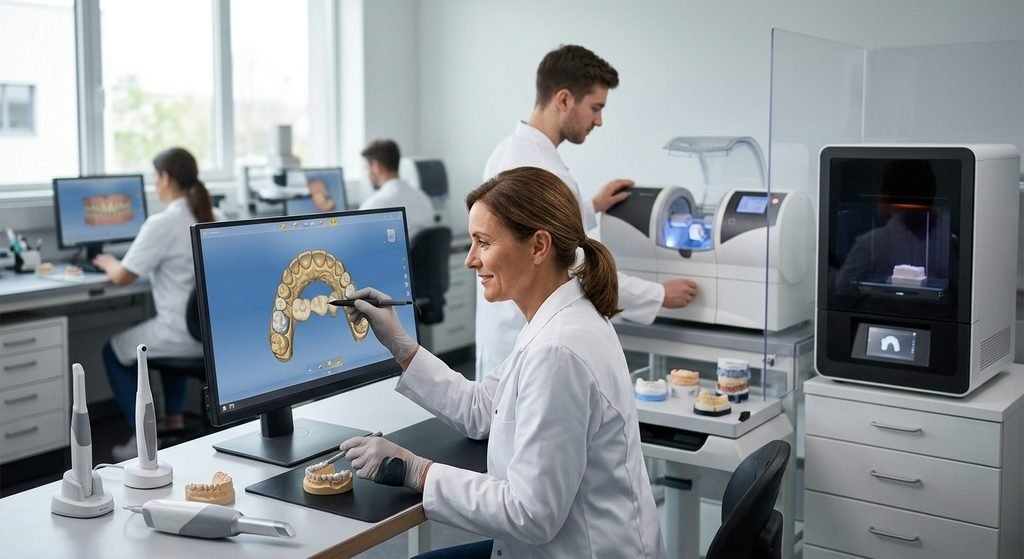
Now many cases arrive as digital files. Intraoral scan integration in the dental lab allows a dentist to capture the mouth with a handheld scanner and send the data within minutes. The lab receives a precise three-dimensional record, checks it, and begins designing almost immediately. There is no shipping delay, no pouring of stone, and no risk of a warped impression. Labs that still receive physical impressions are not left behind, since they can scan the models themselves with a desktop scanner and join the same digital pipeline.
Designing Restorations on Screen
Once the scan is in the system, the technician opens the design software and works on the restoration. Modern programs suggest a starting shape, identify the margin line, and adjust contacts with neighboring teeth. The technician then refines the result, shaping cusps, checking the bite, and making sure the restoration looks natural.
This is where many people misunderstand the technology. CAD software does not replace the technician’s eye. It gives them better tools and removes repetitive steps. A skilled designer still decides how a crown should look next to its neighbors, how translucent it should appear, and how it should behave in a patient’s bite. The best results come from people who understand dental anatomy first and software second. Labs that treat the software as a shortcut for untrained staff usually end up with disappointing restorations.
Milling Machines and Production Efficiency
The manufacturing side has changed just as much. Dental milling machine efficiency has improved with faster spindles, better tool-changing systems, and the ability to run unattended overnight. A lab can load blocks of zirconia, lithium disilicate, or PMMA in the evening and arrive in the morning to find a full batch of restorations ready for finishing.
Five-axis milling units can handle complex shapes with undercuts, and some machines work wet while others work dry, depending on the material. Choosing the right machine depends on the lab’s case mix. A lab focused on zirconia crowns has different needs from one that produces a lot of glass ceramics or titanium abutments. Efficiency also depends on good nesting software, which arranges multiple restorations within a single block to reduce waste. Small improvements in nesting and tool management can save a surprising amount of material over a year.
3D Printing in Dental Labs
While milling cuts away material, additive manufacturing builds it up. 3D printing in dental labs has moved from a novelty to a daily tool, especially for models, surgical guides, aligner molds, temporary crowns, and dentures. Printers are generally less expensive than milling units and can produce many items in a single run, which makes them ideal for high-volume jobs.
Resin printing has improved considerably, and newer materials are approved for permanent restorations in some cases, though the options are still developing. Metal printing is also used for partial denture frameworks and crowns. Many labs now run milling and printing side by side, choosing the method that best fits the case. A model that once took an hour of pouring and trimming can now be printed overnight with almost no hands-on time.
Automated Dental Lab Production and Software
As the number of digital steps grows, labs need a way to manage them. Dental laboratory automation software helps by tracking cases, assigning tasks, nesting jobs, communicating with dentists, and keeping records of every file. Automated dental lab production does not mean the lab runs itself. It means repetitive tasks are handled by the system so that people can focus on work that needs judgment.
Some platforms now use artificial intelligence to suggest margin lines, propose crown designs, and flag potential problems before milling. This can cut design time substantially for routine cases. Even so, human review remains essential, because software can miss details that a trained technician would catch immediately. The healthiest approach treats automation as an assistant rather than a replacement.
Traditional vs Digital Dental Labs: A Side-by-Side View
The contrast between traditional vs digital dental labs is easiest to see when the main points are placed next to each other. Both approaches can produce excellent work, but they differ sharply in speed, consistency, and cost structure.
| Aspect | Traditional Lab | Digital Lab |
|---|---|---|
| Case intake | Physical impressions shipped by courier | Digital scans sent within minutes |
| Design method | Hand-waxed and sculpted | Software-based design with technician review |
| Production | Casting, pressing, and manual layering | Milling and 3D printing |
| Consistency | Varies with the technician | Highly repeatable once settings are tuned |
| Turnaround | Several days to weeks | Often one to three days |
| Data storage | Physical models and paperwork | Digital archive that is easy to search |
| Skill emphasis | Manual craftsmanship | Digital design plus artistic judgment |
This comparison should not be read as a verdict that one is good and the other bad. Many of the best labs blend both worlds, using digital tools for efficiency and hand finishing for the artistry that patients notice in the mirror.
Accuracy of CAD CAM Crowns and Restorations
Dentists care about fit above almost everything else, so the accuracy of CAD CAM crowns is an important part of the conversation. Studies have generally found that well-made digital restorations show marginal fit within clinically acceptable ranges, and in many cases they match or exceed conventionally made ones. A key advantage is consistency. Once a lab has calibrated its scanner, software, and milling machine, it can reproduce results with very little variation.
That said, accuracy depends on every link in the chain. A poor scan, an incorrect margin line, a worn milling bur, or a sintering error can all lead to a crown that does not seat properly. Regular calibration, maintenance, and quality checks are what separate reliable labs from inconsistent ones. The technology provides the potential for accuracy, but the lab’s habits decide whether that potential is realized.
Same Day Dental Restorations and Reducing Turnaround Time
One of the most visible benefits for patients is speed. Same day dental restorations are now possible in clinics with chairside milling units, and many labs support these practices by providing design services, materials, and finishing support. A patient can walk in with a damaged tooth and leave with a permanent crown in a single visit, which was nearly unthinkable a few decades ago.
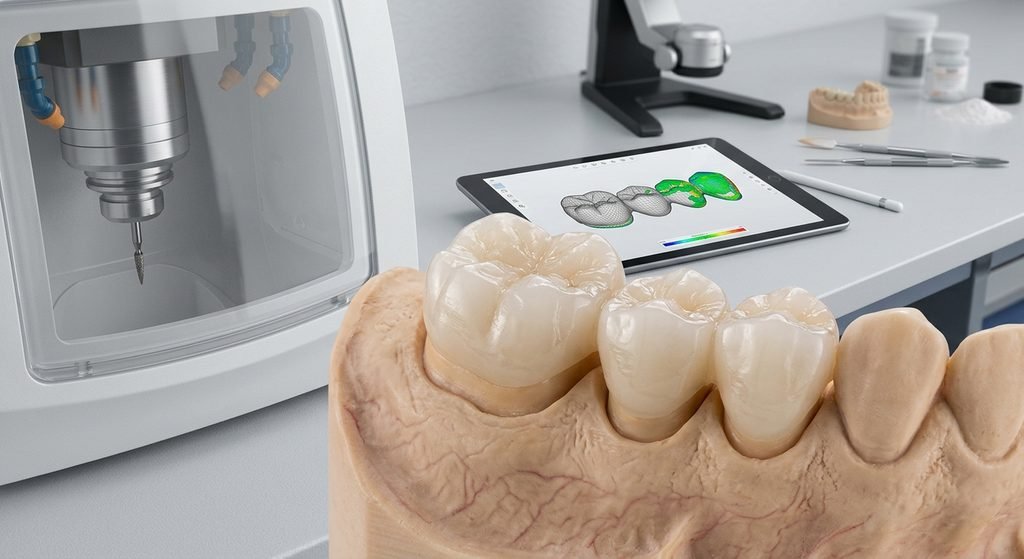
For labs working in the traditional referral model, reducing turnaround time in dental labs is just as valuable. Digital files arrive instantly, designs are completed on screen, and milling can run overnight. Revisions are easier too, since a technician can adjust the design and remill without starting over from a new impression. Faster turnaround helps dentists schedule more efficiently and keeps patients from living with temporary restorations for weeks.
The Benefits of Digital Dentistry for Labs
Taken together, the benefits of digital dentistry for labs go well beyond speed. Labs gain more predictable quality, better records, easier communication with dentists, and the ability to scale without hiring proportionally more staff. Digital archives mean a lost model is no longer a disaster, and a remake can be produced from the stored file in minutes.
Another advantage is the ability to offer new services. Labs can now provide guided implant surgery planning, digital dentures, clear aligner components, and custom abutments, opening revenue streams that were hard to reach before. The table below outlines the main advantages and the challenges that come with them.
| Advantages | Disadvantages |
|---|---|
| Faster turnaround and quicker revisions | High upfront investment in equipment and software |
| Consistent, repeatable quality | Learning curve for technicians |
| Reduced material waste with nesting | Ongoing maintenance and calibration costs |
| Easy digital storage and retrieval of cases | Dependence on software licenses and updates |
| Ability to offer new services such as guides and digital dentures | Risk of poor results if scans or settings are wrong |
| Better communication with dentists through shared files | Need for strong data security practices |
The Cost of Dental CAD CAM Equipment
No honest discussion of this topic can avoid the question of money. The cost of dental CAD CAM equipment can vary widely depending on what a lab chooses. A desktop scanner, design software, a compact milling machine, a sintering furnace, and a 3D printer can together represent a substantial investment, and high-end five-axis mills sit at the top of the price range. Software subscriptions, replacement burs, materials, and service contracts add recurring expenses.
Smaller labs often begin with a scanner and design software, outsourcing milling to a larger partner until volume justifies buying a machine. This staged approach spreads risk and lets the team build skills gradually. It is wise to calculate the break-even point using realistic case volumes rather than optimistic ones. The equipment pays for itself in many labs, but only when it is kept busy and operated by trained staff.
Dental Lab Digital Transformation: People Matter Most
Technology is only half the story of dental lab digital transformation. The other half is people. Technicians who have spent decades mastering wax and porcelain may feel uneasy about moving to a screen, and that concern deserves respect. The most successful labs invest in training, involve their experienced staff in choosing equipment, and make it clear that craftsmanship is still valued.
Many veteran technicians discover that their eye for anatomy and aesthetics makes them excellent digital designers. Meanwhile, younger staff often arrive with strong software skills but need guidance on function and artistry. When both groups learn from each other, the lab becomes stronger than either could be alone. Change managed with patience tends to stick, while change forced from above often leaves resentment behind.
Looking Ahead: Where Digital Labs Are Going Next
The next few years will likely bring even more change. Artificial intelligence is improving automated design, new printable materials are expanding what can be made without milling, and cloud-based platforms are making collaboration between dentists and labs smoother. Industry bodies such as the American Dental Association continue to publish guidance on digital dentistry, and educational resources from organizations like the National Association of Dental Laboratories help technicians keep pace with developments.
Whatever tools arrive, the core purpose of the lab will stay the same: creating restorations that fit well, look natural, and last. Technology is simply changing how that goal is reached.
Final Thoughts on CAD/CAM and the Modern Dental Lab
So how is CAD/CAM technology changing the way dental labs operate? It is making them faster, more consistent, and more connected, while also asking them to invest in equipment and skills. Digital scans replace impressions, software guides the design, and milling machines and printers carry out much of the production. Yet the human element has not disappeared. Skilled technicians still decide what makes a restoration look and feel right.
For labs weighing the move, the best advice is to start with a clear plan, begin with the tools that offer the quickest return, and invest in people as seriously as in machines. Those that do will not only keep up with a changing industry but help shape where it goes next.