

If you have ever stood at the edge of a park trail wondering whether to walk or run, you have already faced one of the most common fitness questions: Walking vs Running for Fat Loss — which one actually works better? The truth is that both activities can help you burn calories and reduce body fat, but they work in different ways, with different levels of intensity, time commitment, and impact on your body. Whether you are just beginning your fitness journey or looking for evidence-based guidance from the Delta fitness authority, understanding the differences between walking and running will help you choose the best option for your goals.

This guide breaks down the science behind walking and running in simple terms, compares calorie burn, explains the benefits and limitations of each option, and provides practical tables to help you choose the approach that matches your goals, fitness level, and daily routine. Whether you are comparing walking vs running for weight loss, exploring incline walking vs running, or curious about the running afterburn effect, this complete guide will help you understand which method may work best for your fat-loss journey.
The Core Science: How Walking and Running Burn Fat
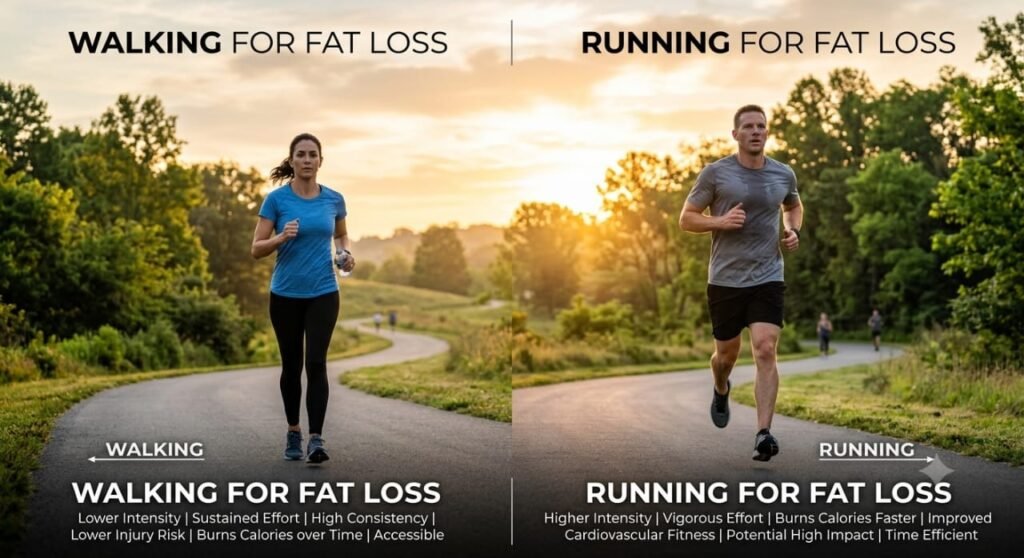
Fat loss ultimately comes down to a calorie deficit, meaning you burn more energy than you consume over time. Both walking and running create this deficit, but they pull energy from different sources and at different rates. Running is a higher-intensity activity that recruits more muscle fibers at once and pushes your heart rate up faster, so it torches calories quickly. Walking, on the other hand, is a lower-intensity, steady effort that your body can sustain for much longer, which changes how it sources its fuel.
At lower intensities, your body leans more heavily on stored fat for energy because there is enough oxygen available to break fat down efficiently. As intensity climbs into a run, your muscles start relying more on carbohydrates (glycogen) because the aerobic fat-burning pathway cannot keep up with the demand. This is why some coaches say walking is better for burning a higher percentage of fat, while running is better for burning a higher total number of calories in a shorter window.
Neither activity is inherently “wrong” for fat loss — the real variable is how many total calories you burn across a week, combined with your diet, sleep, and consistency.
Calorie Burn Comparison: Walking vs Running
Numbers make this easier to visualize. Below is an approximate calorie burn comparison based on a 30-minute session, adjusted by body weight. These are estimates, since actual burn depends on pace, terrain, and individual metabolism, but they give you a realistic starting point drawn from figures commonly cited by exercise physiologists.
| Body Weight | Walking (3.5 mph) – 30 min | Brisk Walking (4.5 mph) – 30 min | Running (6 mph / 10 min mile) – 30 min |
| 130 lbs (59 kg) | ~110 kcal | ~150 kcal | ~240 kcal |
| 155 lbs (70 kg) | ~130 kcal | ~175 kcal | ~290 kcal |
| 180 lbs (82 kg) | ~155 kcal | ~205 kcal | ~340 kcal |
| 205 lbs (93 kg) | ~175 kcal | ~235 kcal | ~390 kcal |
As you can see, running typically burns close to double the calories of a casual walk in the same amount of time. This is one reason running is often recommended when someone needs to create a large calorie deficit quickly. That said, walking for a longer duration can close the gap significantly — a 45 to 60 minute brisk walk can match or exceed the calorie burn of a much shorter run.
Is Walking or Running Better for Weight Loss?
This is the question everyone actually wants answered, and the honest response is: it depends on your goals, your body, and your consistency. Is walking or running better for weight loss really comes down to three factors — total weekly calorie expenditure, injury risk, and long-term adherence.
Running burns more calories per minute, so if your only variable is time efficiency, running wins. However, research has repeatedly shown that people who enjoy their workout are far more likely to stick with it, and roughly half of all exercise program participants drop out within the first six months. A workout that burns more calories on paper is worthless if you stop doing it after three weeks. This is a key point raised by nutrition and fitness which notes that enjoyment and sustainability often outperform raw calorie math over the long run.
There is also the injury factor. Running is a high-impact activity that places roughly two to three times your body weight in force through your joints with every stride. For beginners, people with excess body weight, or anyone with prior joint issues, this raises the risk of shin splints, knee pain, and stress fractures — all of which can derail a weight loss plan entirely if you are sidelined for weeks. Walking carries a much lower injury risk while still delivering meaningful fat-loss benefits when done consistently and briskly.
Best Cardio for Weight Loss: Where Each Fits
When people search for the best cardio for weight loss, they are usually hoping for one single answer, but the truth is that the best cardio is the one you will actually do several times a week for months. That said, here is how walking and running typically fit into a broader cardio strategy:
- Walking works well as a daily, low-stress habit that adds up through consistency and complements strength training without hurting recovery.
- Running works well as a higher-intensity option for people who are already fit enough to handle the impact and want faster calorie burn in shorter sessions.
- Interval training, alternating between walking and running, is increasingly popular because it boosts calorie burn without requiring you to sustain a hard pace the entire time.
Public health guidance recommends that at least 150 minutes of moderate activity per week, which both brisk walking and easy running can satisfy, making either a legitimate foundation for a fat-loss routine.

Zone 2 Cardio for Fat Loss Explained
You may have come across the term zone 2 cardio for fat loss on fitness apps or social media. Zone 2 refers to a heart rate range of roughly 60 to 70 percent of your maximum heart rate, a pace at which you can still hold a conversation without gasping for air. At this intensity, your body predominantly uses fat as fuel because there is enough oxygen supply to support fat oxidation.
Both brisk walking and easy jogging can land you in zone 2, depending on your current fitness level. A trained runner might need to jog to reach zone 2, while a beginner might hit that same heart rate simply by walking uphill. Zone 2 training also improves mitochondrial efficiency over time, meaning your body gradually gets better at burning fat even outside of your workouts.
It is worth noting that zone 2 training burns a higher percentage of fat but a lower total number of calories per minute compared to higher-intensity work. For total fat loss, what matters most is the cumulative calorie deficit across the week, so zone 2 sessions work best when combined with either longer duration or occasional higher-intensity days.
The Running Afterburn Effect (EPOC)
One advantage running has over walking is the running afterburn effect, formally known as excess post-exercise oxygen consumption, or EPOC. After a vigorous workout, your body continues to burn calories at an elevated rate as it works to restore oxygen levels, repair tissue, and return your hormones and body temperature to baseline.
Most of the research shows that afterburn effect adds roughly 6 to 15 percent more calories on top of what you burned during the workout itself, and the effect can last anywhere from thirty minutes to several hours depending on workout intensity. A steady, easy walk produces very little EPOC, while a hard run or interval session produces a much more noticeable afterburn.
This does not mean walking is pointless — far from it — but it does explain why higher-intensity running sessions can have an outsized impact on total weekly calorie burn beyond what a stop.
Incline Walking vs Running
Incline walking vs running is a comparison that has grown in popularity as more people look for lower-impact alternatives to jogging that still deliver a serious calorie burn. Walking uphill, whether outdoors or on a treadmill set to a 10 to 15 percent incline, dramatically increases the effort your glutes, calves, and cardiovascular system have to produce, often matching or exceeding the calorie burn of flat-ground jogging at a similar heart rate.
The major advantage of incline walking is that it delivers running-level intensity without the repeated joint impact of striking the ground at running speed. This makes it an appealing option for beginners, people managing joint pain, or anyone returning from injury who still wants an efficient fat-burning workout. Fitness recommend starting with a moderate incline and gradually working up as your fitness improves, rather than jumping straight to steep grades.
If your knees or hips are not ready for the pounding of regular running, incline walking is one of the most practical middle-ground solutions available.
Walking to Lose Belly Fat: What the Research Says
Many people specifically search for walking to lose belly fat, hoping there is a way to target the midsection directly. Unfortunately, spot reduction is a myth — no exercise, including walking or running, can selectively burn fat from one specific area of your body. Fat loss happens across your entire body based on genetics, hormones, and your overall calorie deficit.
That said, walking regularly does help reduce visceral fat, the deeper fat that surrounds your organs and is linked to higher health risks, as part of an overall consistent exercise and eating pattern. Brisk walking sessions of 45 to 60 minutes, done several times a week, have been associated with meaningful reductions in waist circumference over time. The keyword here is consistency — a single walk will not visibly shrink your waistline, but months of regular walking combined with a sensible diet reliably will.
Running for Quick Weight Loss
If your priority is running for quick weight loss, running does have a real edge in speed. Because it burns roughly double the calories per minute compared to walking, it creates a calorie deficit faster, which matters if you have limited time to exercise each day. A 20-minute run can burn a similar number of calories as a 35 to 40 minute walk, making it a more time-efficient option for busy schedules.
However, “quick” comes with caveats. Ramping up running volume too fast is one of the most common causes of overuse injuries in new runners, and an injury that sidelines you for a month will erase any time advantage you gained. Health and fitness writers, including experts cited by Prevention, generally recommend building a walking base first and gradually introducing short running intervals before committing to regular running sessions purely for speed of results.
How Many Steps a Day for Weight Loss?
The question of how many steps a day for weight loss has shifted a lot in recent research. The popular 10,000-step target actually originated from a 1960s Japanese pedometer marketing campaign, not from a clinical study, so it is more of a memorable round number than a scientifically proven threshold.
More recent research presented at the European Congress on Obesity found that people in weight-loss programs who reached around 8,500 steps per day were significantly more successful at keeping weight off during both the loss and maintenance phases, compared to those who took fewer steps. Other studies referenced by resources like Healthline suggest that benefits can begin appearing anywhere from 6,000 to 8,000 steps per day, particularly for older adults, while more ambitious step counts of 10,000 or higher tend to support larger weight-loss outcomes when paired with a controlled diet.
The practical takeaway: rather than obsessing over hitting an exact number, focus on steadily increasing your daily steps from your current baseline. Someone who moves from 3,000 to 7,000 steps a day will typically see more meaningful results than someone who was already active trying to squeeze out an extra 1,000 steps.
Do’s and Don’ts of Walking and Running for Fat Loss
| Do’s | Don’ts |
| Start with brisk walking if you are a beginner or returning from injury | Don’t jump straight into daily running without building a base |
| Track your total weekly calorie burn, not just single sessions | Don’t rely on exercise alone while ignoring your diet |
| Mix in incline walking or intervals to increase intensity safely | Don’t ignore joint pain or discomfort during running sessions |
| Aim for consistency over intensity in the early weeks | Don’t compare your progress to someone else’s pace or step count |
| Gradually increase running distance or speed by small amounts weekly | Don’t increase running mileage by more than roughly 10% per week |
| Pair cardio with strength training to protect lean muscle | Don’t expect spot reduction of belly fat from walking or running alone |
| Get proper footwear suited to walking or running | Don’t wear worn-out or incorrect shoes for high-impact running |
Walking vs Running: Pros and Cons at a Glance
| Factor | Walking | Running |
| Calorie burn per minute | Lower | Higher (roughly 2x) |
| Joint impact | Low | High |
| Beginner friendliness | Very high | Moderate to low |
| Afterburn effect (EPOC) | Minimal | Noticeable |
| Time efficiency | Lower | Higher |
| Injury risk | Low | Moderate to high |
| Long-term adherence | Generally easier | Can be harder to sustain |
| Best for | Daily habit building, joint issues, beginners | Time-limited schedules, faster results, higher fitness levels |
Which One Should You Choose?
If you are new to exercise, carrying extra body weight, or dealing with joint concerns, walking is the safer and more sustainable starting point. Build a habit of brisk daily walking, gradually add incline or extra distance, and let your fitness improve naturally before considering running.
If you are already reasonably fit, have healthy joints, and are working with a tighter schedule, running can accelerate your calorie deficit and deliver results faster, provided you increase your mileage gradually to avoid injury.
For many people, the smartest approach is not choosing one over the other permanently, but blending both: walking on recovery days, running or interval sessions on higher-energy days, and incline walking as a joint-friendly bridge between the two. This combination keeps your body challenged, reduces injury risk, and keeps workouts varied enough that you are more likely to stick with the plan long term.
Final Thoughts
The walking vs running for fat loss debate does not have a single universal winner, because the best exercise is always the one that fits your body, your schedule, and your ability to stay consistent for months, not days. Running burns calories faster and creates a stronger afterburn effect, while walking is gentler on your joints, easier to sustain daily, and still highly effective when done briskly and consistently. Whichever path you choose, pairing your cardio routine with balanced nutrition, adequate sleep, and some form of strength training will get you closer to lasting fat loss than any single workout choice ever could.