

What’s the Important Difference Between a Mini Dental Implant and a Standard Dental Implant?
If you’ve been researching tooth replacement options, you’ve probably run into two terms that sound almost interchangeable but really aren’t: mini dental implants and standard dental implants. They both do the same basic job — anchoring a replacement tooth or denture securely into your jaw — but the way they get there, who they’re suited for, and even how long they last can look surprisingly different. Understanding mini dental implants vs standard implants isn’t just a technical detail for your dentist to sort out; it genuinely shapes how comfortable, affordable, and quick your treatment ends up being.
Why This Comparison Actually Matters to You
It’s tempting to assume “an implant is an implant,” but the difference between mini and traditional implants can change the entire treatment plan — how much bone you need, how many visits are involved, what it costs, and even how the final tooth feels when you bite down. Some patients are excellent candidates for standard implants and would gain nothing from going smaller. Others have jawbone conditions, health concerns, or budget realities that make mini implants the far more sensible choice. Neither option is universally “better” — they’re built for different situations, and knowing the distinction helps you walk into a consultation asking the right questions instead of just nodding along.
What Exactly Is a Standard Dental Implant?
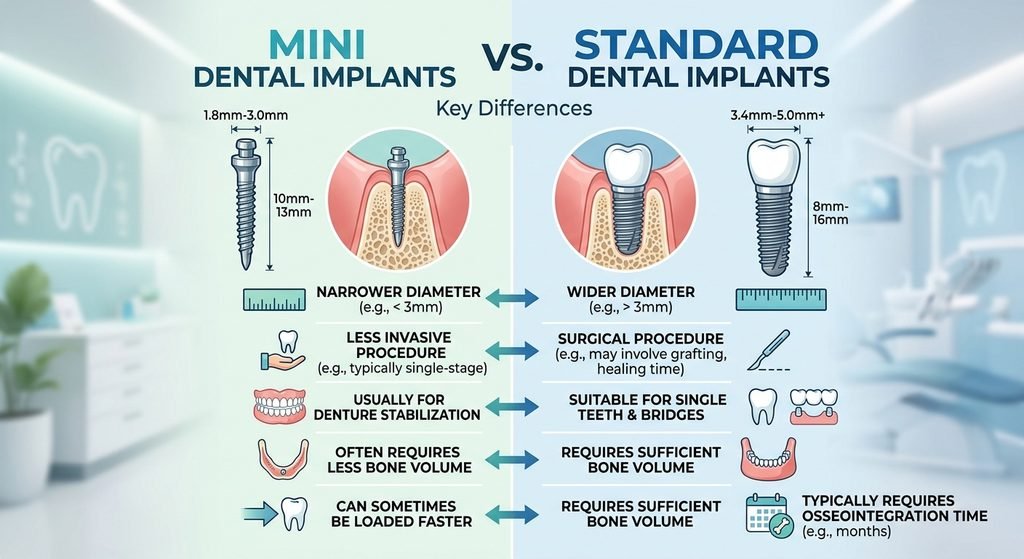
A standard dental implant is the option most people picture when they hear the word “implant.” It’s a titanium post, generally somewhere between 3.5 and 6 millimeters wide, surgically placed deep into the jawbone to act as an artificial tooth root. Because of its width, a standard implant typically needs a healing period of several months, during which the bone gradually fuses to the titanium surface through a process called osseointegration. Once that fusion is solid, an abutment and a crown are attached on top, completing the restoration.
This size and depth are exactly why standard implants have such a strong reputation for durability. They distribute chewing force effectively, mimic a natural tooth root closely, and with good care, can last for decades. The tradeoff is that they demand a certain amount of healthy, dense jawbone to work with — which isn’t something every patient has.
What Exactly Is a Mini Dental Implant?
Mini dental implants work on the same basic principle but at a noticeably smaller scale. The mini dental implant diameter in mm typically falls somewhere between 1.8 and 3.0 millimeters, roughly half the width of a standard implant post. Because they’re so much narrower, they can often be placed in a single, straightforward procedure, frequently without the need for a separate healing phase before the restoration is attached.
Most mini implants are also single-piece rather than two-piece, meaning the post and the small ball-shaped attachment on top are one continuous unit rather than separate components assembled together. This design, combined with their smaller footprint, makes them a genuinely less invasive dental implant option for the right patient — quicker to place, gentler on the surrounding tissue, and often more forgiving when it comes to existing bone volume.
Single-Piece vs Two-Piece Dental Implants: A Design Difference That Matters
This distinction gets glossed over a lot, but it’s actually one of the more meaningful engineering differences between the two implant types. Standard implants are almost always two-piece: the implant post goes into the bone first, heals on its own, and the abutment (which connects to the crown) is attached afterward, usually at a second appointment. This staged approach gives the bone time to integrate fully before it bears any real pressure.
Mini implants, being single-piece by design, combine the post and the attachment point into one unit that’s placed in a single visit. There’s no waiting for a second surgical step to attach anything on top. For patients who want a faster overall timeline, or who simply want fewer procedures, this single-piece approach is a meaningful part of the appeal — though it does mean the two implant types heal and get restored in genuinely different ways.
Dental Implant Size Comparison: Side by Side
Sometimes the easiest way to see the difference is to look at the numbers directly next to each other.
| Feature | Standard Dental Implant | Mini Dental Implant |
|---|---|---|
| Typical diameter | 3.5–6.0 mm | 1.8–3.0 mm |
| Design | Two-piece (post + separate abutment) | Single-piece (post + attachment combined) |
| Bone requirement | Higher; often needs adequate bone density/volume | Lower; suited to narrower or thinner ridges |
| Healing time before restoration | Often 3–6 months | Can often be restored same-day or within days |
| Surgical invasiveness | More involved; may include flap surgery | Minimally invasive; often flapless placement |
| Best suited for | Single teeth, larger restorations, long-term stability | Denture stabilization, narrow ridges, smaller restorations |
Small Diameter Dental Implants and Who They’re Really For
Small diameter dental implants aren’t a “lesser” version of a standard implant — they’re a specifically engineered solution for situations where a full-sized implant simply isn’t practical. Patients with narrow ridge dental implants needs, meaning their jawbone has thinned out over time (which commonly happens after tooth loss or long-term denture wear), often don’t have enough width to safely place a standard-sized post without additional bone-building procedures first.
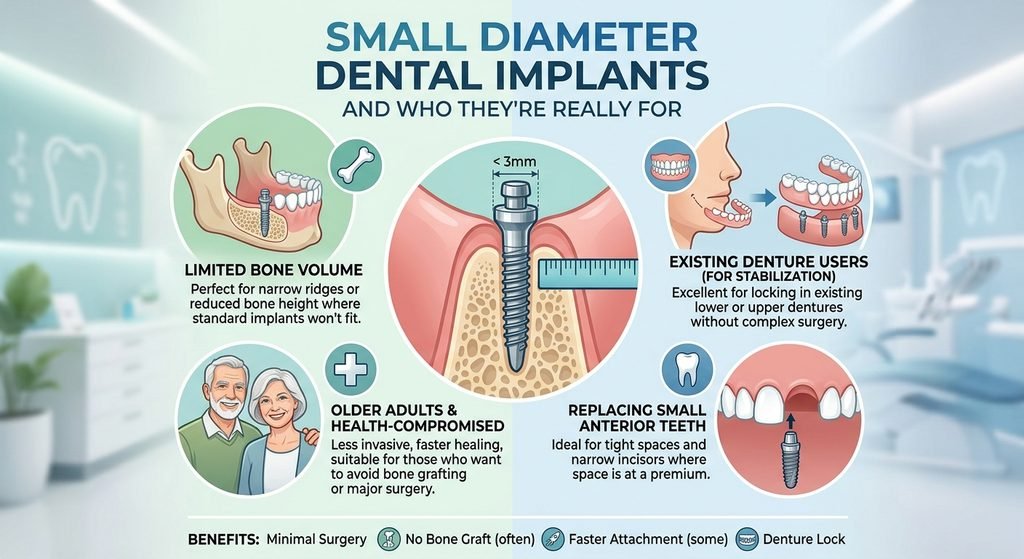
Mini implants sidestep that problem by requiring far less bone width to begin with. They’re also frequently recommended for older patients or those with certain health conditions where a longer, more invasive surgery isn’t ideal. That said, they’re not automatically the right choice just because they’re easier to place — a dentist still needs to evaluate bite force, bone quality, and the specific restoration being planned before recommending one option over the other.
Denture Stabilization With Mini Implants: A Common, Practical Use
One of the most popular applications for this technology is denture stabilization with mini implants. Traditional dentures rest on the gums and can shift, slip, or cause irritation, especially while eating or speaking. Mini implants offer a way to anchor a denture firmly in place without the more extensive surgery a full implant-supported denture would typically require.
In many cases, four mini implants are placed along the jaw, and the denture is fitted with corresponding attachments that snap onto the implant heads, holding it securely while still allowing it to be removed for cleaning. Because mini implants often support immediate loading (more on that shortly), some patients walk out with a noticeably more stable denture on the very same day the implants are placed — a huge quality-of-life difference for people who’ve dealt with slipping dentures for years.
Immediate Load Mini Implants: Same-Day Results
This is one of the features that draws a lot of patients toward mini implants specifically. Immediate load mini implants can often support a temporary or even a final restoration right away, rather than requiring months of healing before any tooth or denture is attached. This is possible partly because of their design and partly because the initial stability they achieve in the bone, even before full osseointegration, is often sufficient to handle light-to-moderate chewing force early on.
Standard implants can sometimes be immediately loaded too, but it’s far less common and depends heavily on bone quality and implant positioning. For most standard implant cases, the safer, more predictable path is still to wait for full healing before adding permanent pressure. If a fast turnaround matters to you, this is genuinely one of the more significant practical differences between the two options.
Bone Graft for Standard Implants: When It’s Needed and Why
Bone volume is often the deciding factor in which implant type ends up being recommended. A bone graft for standard implants becomes necessary when the jawbone has thinned or doesn’t have enough height or width to securely anchor a full-sized implant post. This is common after teeth have been missing for a while, since the bone that used to support them tends to gradually resorb without that stimulation.
Grafting adds time, cost, and an additional healing period, often several months, before the implant itself can even be placed. It’s a well-established, reliable procedure, but it’s also one of the bigger reasons patients sometimes look into mini implants instead — not necessarily because mini implants are “better,” but because they may avoid the need for grafting altogether in cases where bone loss isn’t too severe.
| Standard Implant Considerations | Mini Implant Considerations |
|---|---|
| May require bone grafting if ridge is thin | Often avoids grafting due to smaller diameter |
| Longer overall treatment timeline | Typically faster, sometimes single-visit |
| Higher long-term load-bearing capacity | Lower load capacity; best for lighter restorations |
| More surgical steps (flap, healing, abutment) | Fewer steps; frequently flapless placement |
| Generally higher upfront cost | Generally lower upfront cost |
Cost of Mini Dental Implants vs Traditional Implants
Budget plays a real role in this decision for a lot of people, and it’s worth being upfront about it. The cost of mini dental implants vs traditional implants tends to favor mini implants fairly significantly — they’re usually less expensive per implant, partly because the procedure is shorter, less invasive, and often doesn’t require the additional cost of bone grafting or multiple surgical visits.
That said, cost shouldn’t be the only factor in the decision. A standard implant, while pricier upfront, is often the more durable long-term solution for replacing a single tooth or supporting a larger restoration, and it may end up costing less over a lifetime if it means avoiding replacements down the line. Mini implants can be excellent value specifically for denture stabilization or in patients where a standard implant simply isn’t medically appropriate — but comparing cost without factoring in the right clinical fit for your situation would be missing half the picture.
Advantages and Disadvantages of Each Option
Here’s a clearer breakdown of where each type tends to shine, and where it tends to fall short.
| Advantages | Disadvantages | |
|---|---|---|
| Standard Implants | Excellent long-term durability; strong for chewing force; well-suited to single-tooth replacement | Requires more bone; longer healing time; higher cost; more invasive surgery |
| Mini Implants | Less invasive; often same-day results; lower cost; great for narrow ridges and denture stabilization | Lower load capacity; may not suit heavy bite forces; long-term durability data is more limited |
Less Invasive Dental Implant Options and Why That’s Appealing
For a lot of patients, particularly those who’ve put off treatment out of fear of extensive surgery, less invasive dental implant options are a genuine relief to hear about. Mini implants, with their smaller size and frequently flapless placement technique (meaning no cutting and folding back of the gum tissue), tend to come with less swelling, less discomfort, and a noticeably shorter recovery window compared to standard implant surgery.
This doesn’t mean mini implants are always the “easy” choice without tradeoffs — as covered above, they’re simply not appropriate for every situation, particularly where heavier bite force or a single missing molar is involved. But for the right patient, especially someone stabilizing a denture or working with a narrower ridge, the reduced invasiveness can make the entire experience far less intimidating.
How a Dentist Decides Which One Is Right for You
This decision isn’t something you should make purely from an article or a quick online comparison, and any good dentist will tell you the same. A proper evaluation usually involves a clinical exam, imaging such as a CT scan to assess bone volume and density, a review of your overall health and any medications that might affect healing, and an honest conversation about what you actually need the implant to do — replace a single tooth, support a full denture, or something in between.
According to the American College of Prosthodontists, the right implant approach depends heavily on individual factors like bone quality, the number of teeth being replaced, and a patient’s overall oral health, which is exactly why a personalized consultation matters more than a general comparison chart ever could [1]. Two people who both want “an implant” might walk away from a consultation with completely different recommendations, and that’s not inconsistency — that’s good, individualized care.
Recovery and Long-Term Care: What to Expect Either Way
Regardless of which type you end up with, aftercare plays a big role in how well the implant performs over time. Standard implants generally require a longer initial healing period, careful attention to oral hygiene during that time, and follow-up visits to confirm osseointegration is progressing properly before the final restoration is placed. Mini implants, while quicker to place and often loaded sooner, still need the same level of long-term hygiene commitment — brushing, flossing (or using implant-specific cleaning tools), and regular dental checkups to keep the surrounding tissue healthy.
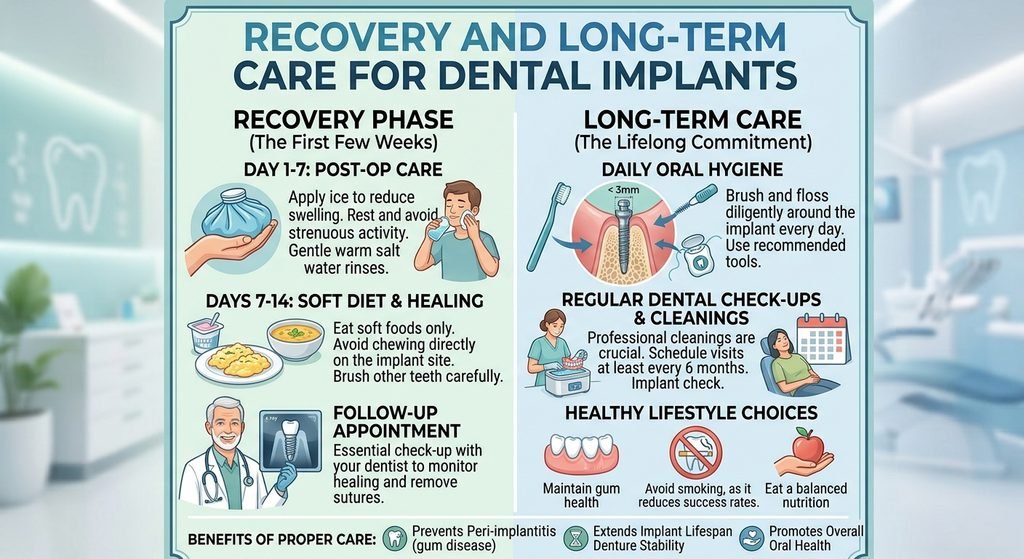
Neither implant type is “maintenance-free.” Both rely on consistent oral hygiene and periodic professional monitoring to last as long as they’re capable of lasting, which for either type, when properly cared for, can mean many years of reliable use.
Do’s and Don’ts When Choosing Between Mini and Standard Implants
Since this decision comes up so often, here’s a simple, practical reference to keep in mind.
| Do | Don’t |
|---|---|
| Get a proper bone density evaluation before choosing | Assume mini implants are automatically “easier” without checking suitability |
| Ask your dentist about long-term load capacity for your specific case | Choose based on price alone without considering durability |
| Consider mini implants seriously for denture stabilization | Rule out standard implants just because they take longer to heal |
| Discuss bone grafting options if your ridge is narrow | Skip imaging or a full clinical evaluation to save time |
| Commit to consistent oral hygiene regardless of which type you choose | Assume either implant type is maintenance-free once placed |
Bringing It All Together
At the end of the day, the difference between mini and traditional implants comes down to size, design, invasiveness, and the specific job each one is built to do. Standard implants remain the gold standard for durability and long-term load-bearing, particularly for single-tooth replacement, while mini implants offer a genuinely valuable, less invasive, and more budget-friendly alternative — especially for denture stabilization or patients dealing with a narrower jawbone ridge. Neither is objectively superior; they’re simply different tools designed for different mouths and different needs.
If you’re weighing this decision yourself, the most useful next step isn’t more online comparison charts — it’s a proper consultation, complete with imaging and an honest conversation about your bone health, your budget, and what you actually want your new tooth or denture to do for you day to day. Getting that part right matters far more than which implant size sounds more appealing on paper.