

White Bumps Around Eyes:
You are standing in front of the mirror, getting ready for the day, and there they are again — those small, stubborn white bumps sitting quietly under your eyes or along your eyelids. They do not hurt. They do not itch. But they refuse to leave, and no amount of concealer seems to hide them properly. If this sounds familiar, you are far from alone. White bumps around the eyes are one of the most common cosmetic skin concerns people bring up with dermatologists, and the reasons behind them range from completely harmless to conditions that deserve a bit more attention. This article walks you through everything you need to know — what these bumps actually are, why they show up, and what you can realistically do about them.
Why the Skin Around Your Eyes Is So Prone to Bumps
The skin surrounding your eyes is thinner and more delicate than skin almost anywhere else on your body. It has fewer oil glands, yet it is also packed with tiny structures like sweat glands, hair follicles, and oil-producing glands along the eyelid margin. Because this area is so thin and so frequently touched, rubbed, and layered with makeup and eye cream, it becomes an easy target for blocked pores, trapped keratin, and cyst formation. Add in factors like sun exposure, aging, and the natural slowdown of skin cell turnover, and it is easy to see why bumps love to gather right where we notice them the most — around our eyes.
Milia Around Eyes: The Most Common Culprit
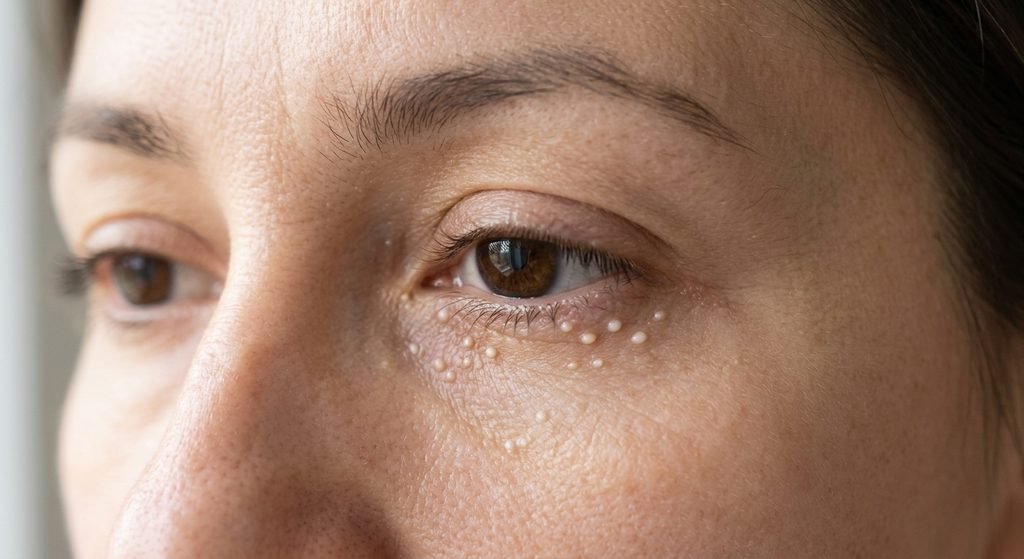
If you have ever noticed tiny, firm, pearl-white dots clustered under your eyes or on your eyelids, chances are you are dealing with milia. Milia around eyes are small keratin-filled cysts that form just under the surface of the skin. Unlike pimples, they have no opening, so they cannot be squeezed out the way a whitehead can. Milia are sometimes called “milk spots” because of their pale, milky appearance, and they are incredibly common in both babies and adults.
In infants, milia usually appear on the nose and cheeks and disappear within a few weeks without any treatment. In adults, milia around eyes tend to be more persistent and are often linked to sun damage, heavy skincare products, or skin trauma such as blistering or burns. They are completely harmless from a medical standpoint, but many people still want them gone simply because of how they look.
What Causes Milia? Understanding Keratin Buildup Under Skin
To understand milia, it helps to understand keratin. Keratin is a tough, fibrous protein that makes up the outer layer of your skin, hair, and nails. Normally, dead skin cells containing keratin flake away as part of your skin’s natural renewal cycle. When this process is disrupted, keratin buildup under skin occurs, and it becomes trapped in a small pocket rather than shedding naturally. Over time, this trapped keratin hardens into the small white bump we recognize as a milium.
Several factors contribute to this buildup:
- Overuse of heavy, oil-based creams and thick makeup
- Skipping regular exfoliation, allowing dead skin cells to accumulate
- Sun damage, which thickens the outer skin layer
- Skin trauma such as blisters, rashes, or burns during healing
- Long-term use of steroid creams
- A genetic tendency, since milia often run in families
It is worth noting that milia are not caused by poor hygiene or by bacteria, so no amount of scrubbing will “clean them away.” They form beneath the skin’s surface, which is exactly why home extraction attempts so often fail or cause irritation instead of results.
Blocked Oil Glands Eyelid: Another Piece of the Puzzle
While milia are linked to keratin, another type of bump around the eyes comes from blocked oil glands eyelid tissue naturally contains. Your eyelids house tiny oil-producing glands, including the meibomian glands along the lash line, which help keep your eyes lubricated. When these glands become blocked with excess oil or debris, they can swell into a firm lump — a condition known medically as a chalazion, which we will cover in detail shortly. This is a useful distinction to keep in mind: not every bump on the eyelid is milia. Some are the result of blocked oil glands rather than trapped keratin, and the two need slightly different approaches.
Whiteheads Under Eyes vs Milia: What’s the Real Difference?
People frequently confuse whiteheads under eyes with milia, and it is easy to understand why — both look like small white or yellowish bumps. However, they form in different ways and require different handling.
| Feature | Milia | Whiteheads (Closed Comedones) |
|---|---|---|
| Cause | Trapped keratin beneath the skin | Clogged pore filled with oil and dead skin |
| Texture | Hard, firm, cyst-like | Softer, slightly raised |
| Opening | No visible pore opening | Often has a tiny pore opening |
| Can be popped? | No, resistant to squeezing | Sometimes, though not recommended |
| Common location | Under eyes, eyelids, cheeks | Anywhere with active oil glands |
| Associated with acne? | No | Yes, part of the acne family |
Understanding this difference matters because treating milia like a pimple — by squeezing or picking at it — almost never works and can leave you with irritation, redness, or even scarring.
Syringoma: When Sweat Glands Cause the Bumps
Not every bump around the eyes is related to keratin or oil. Syringoma is a benign growth that develops from the eccrine sweat glands, and it commonly appears as multiple small, skin-colored, yellowish, or slightly translucent bumps just under the lower eyelids. Unlike milia, syringomas are usually symmetrical, appearing in clusters on both sides of the face, and they tend to show up during puberty or adulthood, with women being affected more often than men.
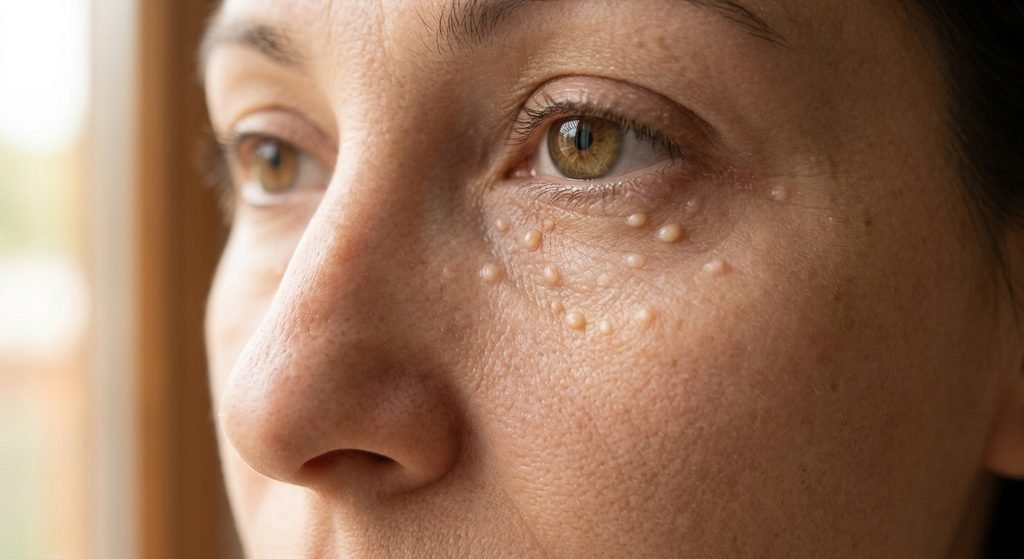
Syringomas are entirely benign and are not linked to any internal disease, though there does appear to be a genetic and hormonal component. They do not resolve on their own the way milia sometimes can, and because they originate from a different type of skin structure, typical exfoliation or retinoid creams have limited effect. Treatment usually requires a dermatologist using methods like laser therapy, electrodesiccation, or minor surgical removal.
Xanthelasma: Cholesterol Deposits Around Eyes
Xanthelasma looks quite different from milia or syringoma. Instead of small individual bumps, xanthelasma presents as soft, yellowish, flat or slightly raised patches, usually forming near the inner corners of the upper or lower eyelids. These are cholesterol deposits around eyes that build up within the skin, and while they are not painful or dangerous by themselves, they can sometimes be a visible signal of underlying lipid imbalances.
This is the one type of “white bump” on this list that genuinely deserves a conversation with your doctor, because xanthelasma has been associated in some individuals with high cholesterol or other lipid disorders. Not everyone with xanthelasma has abnormal cholesterol levels, but given the possible connection, a simple blood lipid panel is a reasonable and worthwhile step. Cosmetic removal options include chemical peels, laser treatment, cryotherapy, or surgical excision, though recurrence is fairly common if the underlying cholesterol levels are not addressed.
Chalazion: A Different Kind of Eyelid Bump
A chalazion is not related to milia, syringoma, or cholesterol at all. It forms when one of the oil glands in the eyelid, called a meibomian gland, becomes blocked. Unlike the tiny, multiple bumps of milia or syringoma, a chalazion is typically a single, firm lump that can grow larger over a few days, sometimes reaching the size of a pea. It usually starts out painless, though it may become red, swollen, or tender if it gets irritated or infected.
Chalazia are more common in adults between 30 and 50 years old, and people with rosacea, blepharitis, or seborrheic dermatitis tend to be more prone to developing them. Most chalazia resolve on their own within a few weeks with warm compresses and gentle lid massage. Larger or persistent ones may require a visit to an ophthalmologist for drainage or a steroid injection. It is worth noting that a chalazion is sometimes confused with a stye, but a stye is caused by a bacterial infection of an eyelash follicle and tends to be more painful and faster developing, while a chalazion develops slowly and is usually not infectious. You can read more about how chalazia are diagnosed and treated on the Mayo Clinic’s condition overview page.
Comparing the Main Types of Eyelid Bumps
Since so many different conditions can cause white or pale bumps around the eyes, a side-by-side comparison can make it easier to figure out which one you might be dealing with.
| Condition | What It Looks Like | Underlying Cause | Typical Treatment |
|---|---|---|---|
| Milia | Tiny, firm, pearly-white dots, often in clusters | Trapped keratin under the skin | Retinoids, gentle exfoliation, professional extraction |
| Whiteheads | Small raised bumps, sometimes with a visible pore | Clogged pore with oil and dead skin | Salicylic acid, gentle cleansing, dermatologist extraction |
| Syringoma | Multiple small, skin-colored or yellowish bumps, symmetrical | Overgrowth of sweat gland cells | Laser therapy, electrodesiccation, minor surgery |
| Xanthelasma | Soft, flat, yellowish patches near eyelid corners | Cholesterol deposits in the skin | Chemical peels, laser, cryotherapy, surgical removal |
| Chalazion | Single firm lump, may grow over days | Blocked meibomian (oil) gland | Warm compresses, lid massage, drainage if persistent |
How to Get Rid of White Bumps Under Eyes Safely
The approach you take really does depend on which type of bump you are dealing with, but there are some general principles that apply across the board. If you are wondering how to get rid of white bumps under eyes, here is what dermatologists commonly recommend.
Topical retinoids for milia are one of the most widely recommended first steps. Products containing tretinoin or adapalene speed up skin cell turnover, which helps the skin naturally release trapped keratin over time. They will not work overnight, but consistent use over several weeks often shows visible improvement.
Gentle exfoliation for under-eye bumps is another effective, low-risk strategy. Mild chemical exfoliants like glycolic acid or salicylic acid help clear away the dead skin cells that contribute to blockages, without the harshness of physical scrubs, which can be too abrasive for the delicate eye area.
Milia extraction performed by a licensed dermatologist or esthetician is considered the gold standard for stubborn milia. A sterile needle is used to gently create a tiny opening, after which the hardened keratin plug is carefully removed. This should never be attempted at home, since the skin around the eyes is thin and prone to scarring or infection if handled incorrectly.
For syringoma, xanthelasma, and chalazion, at-home skincare generally will not resolve the underlying issue, and professional treatment such as laser therapy, minor surgery, or warm compress therapy tends to be necessary.
Do’s and Don’ts for Managing White Bumps Around the Eyes
| Do’s | Don’ts |
|---|---|
| Use a gentle, fragrance-free cleanser twice a day | Don’t scrub the eye area harshly |
| Introduce retinoids gradually and only as tolerated | Don’t apply strong actives directly into the eyes |
| See a dermatologist for extraction or laser treatment | Don’t try to pop or squeeze milia at home |
| Wear sunscreen daily, even on cloudy days | Don’t skip sun protection around the eyes |
| Switch to non-comedogenic, oil-free products | Don’t use heavy, oil-based creams if you are prone to milia |
| Get a cholesterol check if you notice xanthelasma | Don’t ignore recurring or growing eyelid lumps |
| Use warm compresses for a chalazion | Don’t rub your eyes frequently with unwashed hands |
Choosing the Best Eye Cream That Doesn’t Cause Milia
Since heavy, occlusive products are one of the most common triggers for milia, choosing the right eye cream matters more than people often realize. Look for formulas labeled “non-comedogenic” and avoid products with heavy mineral oils, thick waxes, or petroleum-based occlusives high on the ingredient list, especially if you have a history of milia. Lightweight, water-based, or gel formulas with ingredients like hyaluronic acid, niacinamide, or peptides tend to hydrate effectively without clogging the delicate skin around the eyes. If you are especially prone to milia, a product containing a low concentration of retinol or a gentle chemical exfoliant can double as both a hydrating and a preventive step, though it is wise to patch test first since this area of skin is sensitive.
When Should You See a doctor?
Most white bumps around the eyes are harmless and purely cosmetic, but there are situations where a professional opinion is genuinely important. You should consider seeing a dermatologist or eye doctor if a bump grows quickly, becomes painful, affects your vision, bleeds, changes color, or keeps coming back after treatment. Xanthelasma in particular is worth mentioning to your doctor, since it can occasionally point toward elevated cholesterol that would otherwise go unnoticed. Similarly, a chalazion that does not improve after a couple of weeks of warm compresses, or one that seems to be infected with increasing redness and pain, needs medical attention rather than home care. The American Academy of Dermatology is a reliable resource for further reading on any of these skin conditions and can also help you locate a board-certified dermatologist near you.

Prevention: Keeping Future Bumps at Bay
While you cannot control genetics or completely prevent every bump from forming, a few consistent habits go a long way in reducing your risk. Regular but gentle exfoliation keeps dead skin cells from accumulating. Choosing lightweight, non-comedogenic skincare avoids clogging delicate pores around the eyes. Daily sunscreen protects against the kind of sun damage that thickens skin and encourages milia formation. Good eyelid hygiene, including removing eye makeup thoroughly every night, reduces the risk of blocked oil glands and chalazia. And if cholesterol is a known concern for you, keeping it in check through diet, exercise, or medication may reduce the likelihood of new xanthelasma deposits appearing.
Final Thoughts
White bumps around the eyes can be frustrating simply because they sit in such a visible spot, but the good news is that the vast majority of them — whether milia, whiteheads, syringoma, or xanthelasma — are harmless from a health perspective. Understanding which type you are actually dealing with is the first step toward choosing the right treatment, whether that means a gentle retinoid, a professional extraction, or simply a bit of patience while your skin naturally renews itself. If a bump ever changes rapidly, causes pain, or worries you for any reason, do not hesitate to get it checked out. A quick visit to a dermatologist can offer peace of mind and, often, a much faster path to clearer, smoother skin around your eyes.
2 Comments