

Why Is a Dental Checkup Useful Even When Your Teeth Don’t Hurt?
Most of us treat the dentist like a fire alarm — something we only think about once smoke is already in the room. If nothing aches, nothing feels loose, and there’s no obvious stain screaming for attention, it’s easy to assume everything inside your mouth is running smoothly. But here’s the uncomfortable truth: pain is one of the last symptoms to show up in dental problems, not the first. By the time a tooth actually hurts, decay or infection has often been quietly progressing for months, sometimes years. This is exactly why understanding the importance of regular dental checkups matters so much, even — especially — when you feel completely fine.
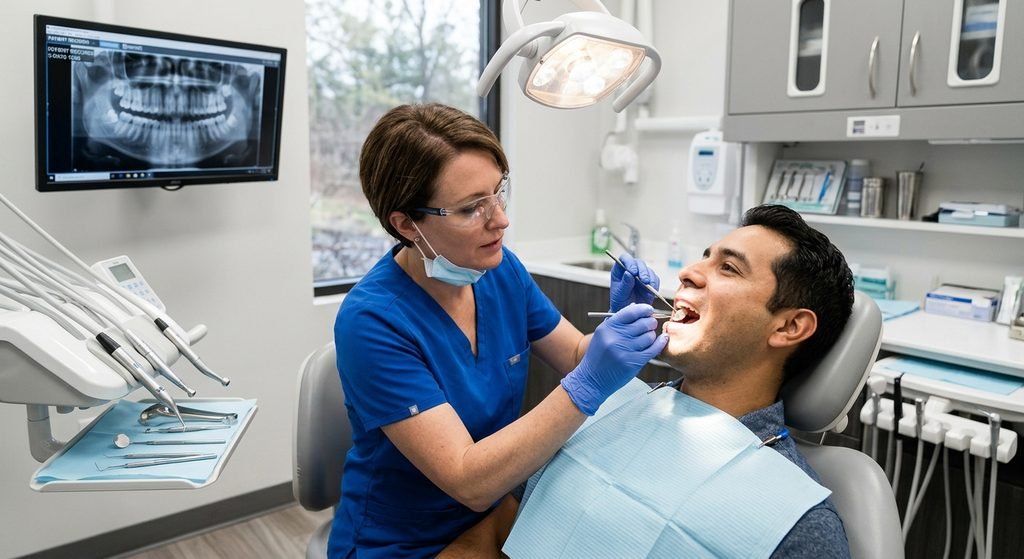
Why Go to the Dentist If Nothing Hurts?
This is the question almost everyone asks at some point, usually right before cancelling an appointment. The honest answer is that your mouth is remarkably good at hiding problems until they become serious. Cavities can form between teeth where you can’t see or feel them. Gum disease in its early stage causes almost no discomfort at all. Even oral cancer, in its initial phase, rarely announces itself with pain.
A dentist isn’t just checking for cavities during a routine visit — they’re looking at your bite, your jaw joints, your gum tissue, the soft tissue of your cheeks and tongue, and even your lymph nodes. None of that requires you to be in pain first. Waiting for pain before booking preventive dental care is a bit like waiting for your car engine to seize up before ever checking the oil. Technically you can do it that way, but you’ll pay far more for the privilege, and the damage may already be irreversible by the time you notice.
Early Detection of Tooth Decay Before It Becomes a Problem
One of the biggest reasons dentists keep pushing for regular visits is early detection of tooth decay. Cavities don’t start as the visible dark holes people imagine. They begin as tiny, painless weak spots in the enamel — areas where minerals have started leaching out faster than your saliva can replace them. At this microscopic stage, decay is often reversible with fluoride treatment and better home care, no drilling required.
Left unchecked, that same spot pushes deeper into the tooth. Once it reaches the dentin layer, sensitivity might start. Once it reaches the nerve, you’re looking at a root canal instead of a five-minute filling. This progression is precisely why asymptomatic cavities are considered one of the sneakiest threats in dentistry — you genuinely cannot feel them until it’s often too late for the simple fix. A dentist using a mirror, a probe, and sometimes X-rays can catch this in its earliest, cheapest, least invasive stage.
Asymptomatic Cavities: The Silent Damage You Can’t Feel
It’s worth dwelling on this point a little longer because it trips up so many otherwise health-conscious people. Asymptomatic cavities are, by definition, cavities that give you no warning signs whatsoever. No twinge when you drink something cold. No ache when you chew. Nothing. They tend to hide:
- Between teeth, where a toothbrush bristle can’t fully reach
- Under old fillings, where the edges have started to break down
- Along the gumline, where plaque quietly builds up
- On chewing surfaces, tucked into deep grooves
Because these spots are invisible to the naked eye and painless to the nerve, the only reliable way to catch them is through a professional exam, often supported by dental X-rays. Skipping checkups because “nothing hurts” essentially means you’re relying on luck rather than evidence.
Signs of Silent Gum Disease Most People Miss
Gum disease is arguably an even bigger stealth threat than tooth decay, because it doesn’t just damage a single tooth — it can eventually affect the bone and tissue holding all your teeth in place. The signs of silent gum disease are easy to dismiss as normal: gums that bleed slightly when you floss, a bit of puffiness along the gumline, breath that’s not quite fresh even after brushing. Most people shrug these off as minor or assume they’re just “how gums are.”
In reality, bleeding gums are inflammation, and inflammation is your immune system responding to bacteria that shouldn’t be there. Left alone, gingivitis (the early, reversible stage) can progress into periodontitis, where the bone supporting your teeth starts to break down. Periodontitis is a leading cause of adult tooth loss, and unlike a cavity, it usually doesn’t cause pain until it’s advanced. A hygienist measuring gum pocket depth during a checkup can catch this shift long before you’d ever notice it yourself.
The Role of Plaque and Tartar Removal in Oral Health
You can brush and floss diligently every single day and still not remove everything. Plaque that isn’t cleared away within about 48 hours starts hardening into tartar (also called calculus), and tartar cannot be removed with a toothbrush at home — it needs professional tools. This is where plaque and tartar removal during a professional dental cleaning becomes essential rather than optional.
Tartar tends to build up fastest in spots that are already hard to reach: behind the lower front teeth, along the back molars, and just beneath the gumline. Once it hardens there, it becomes a rough surface that attracts even more plaque, creating a snowball effect. A dental hygienist uses specialized instruments to scale away this buildup, smoothing the tooth surface again so plaque has a harder time sticking in the future. This single step, done every six months or so, prevents a surprising amount of long-term damage.
| Home Care (Daily) | Professional Cleaning (Every 6 Months) |
|---|---|
| Removes soft, fresh plaque | Removes hardened tartar/calculus |
| Reaches most visible tooth surfaces | Reaches below the gumline and between teeth |
| Reduces bacteria temporarily | Physically scales away buildup with instruments |
| Cannot reverse hardened deposits | Polishes teeth, reducing future plaque adhesion |
| Needed every single day | Needed periodically, but non-negotiable |
Oral Cancer Screening: A Quiet Step with Serious Impact
This is a part of the checkup many patients don’t even realize is happening. During a routine exam, most dentists perform an oral cancer screening — visually and physically examining your lips, cheeks, tongue, floor of the mouth, and throat for anything unusual, such as sores that won’t heal, discoloured patches, or lumps.
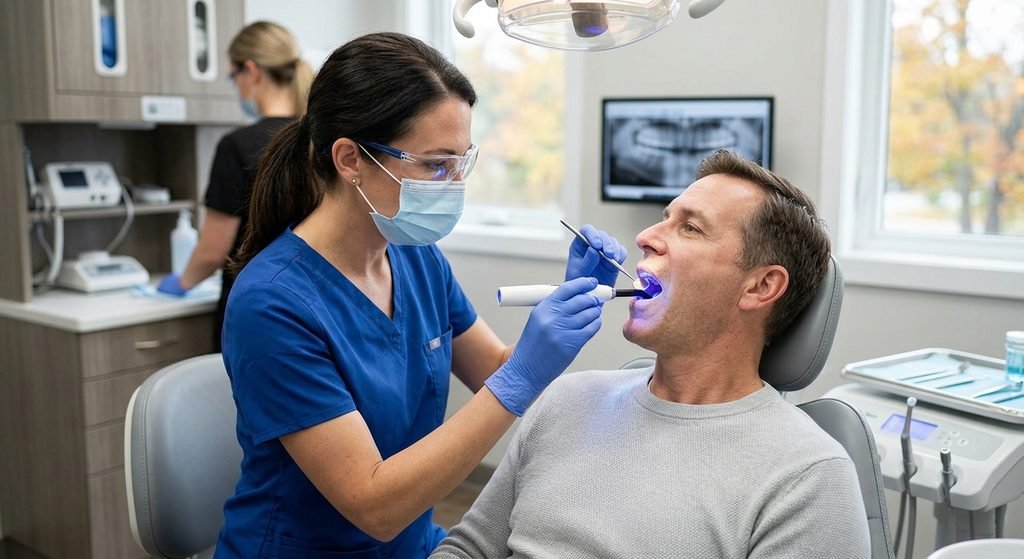
Oral cancer is far more treatable when caught early, and early-stage lesions are typically painless. This screening takes just a couple of minutes and costs you nothing extra beyond the regular visit, yet it’s one of the more genuinely life-saving elements of preventive dental care. People who use tobacco or alcohol regularly are at higher risk, but oral cancer can appear in anyone, which is part of why this screening is done routinely rather than only when a patient reports symptoms.
Dental X-Rays Benefits: Seeing What the Eye Cannot
A visual exam only shows the surface. The real value of dental X-rays benefits lies in revealing what’s happening beneath it — between teeth, under old fillings, inside the bone, and around the roots. X-rays can uncover:
- Decay hiding between teeth, invisible to a mirror
- Bone loss from gum disease, not yet visible in the mouth
- Impacted or misaligned teeth before they cause crowding
- Cysts, abscesses, or other abnormalities near the roots
- Problems developing under existing crowns or fillings
Modern digital X-rays use a very low dose of radiation, and dentists space them out appropriately based on your individual risk level rather than taking them at every single visit. Skipping this diagnostic tool because your teeth “look fine” means missing a whole layer of information that simply isn’t visible any other way.
The Oral-Systemic Health Connection: More Than Just Teeth
Perhaps the most underappreciated reason to keep up with checkups is the oral-systemic health connection — the growing body of research linking the health of your mouth to the health of your entire body. Chronic gum inflammation has been associated with an increased risk of heart disease, and the relationship between gum disease and diabetes appears to run in both directions, with each condition capable of making the other harder to control.
Pregnant women with untreated gum disease have shown links to complications such as premature birth. Even respiratory conditions can be influenced by bacteria travelling from the mouth. According to the Project Access NW overview of routine dental exams, checkups aren’t just about the mouth in isolation — oral health is genuinely tied to whole-body wellbeing, and catching inflammation or infection early can matter well beyond your smile.
This connection is exactly why a dentist will sometimes ask about your general health history, medications, or recent diagnoses. Your mouth often reflects, or even influences, what’s happening elsewhere in your body.
Cost-Effective Dentistry: Paying a Little Now vs. a Lot Later
Let’s talk money, because it’s usually the real reason people skip appointments. A checkup and cleaning cost far less than a filling. A filling costs far less than a root canal. A root canal costs far less than an extraction followed by an implant or bridge. This is the essence of cost-effective dentistry — prevention is consistently the cheapest option on the table, even though it doesn’t always feel that way when you’re booking time off work for something that “isn’t urgent.”
| Stage of Treatment | Typical Complexity | Relative Cost |
|---|---|---|
| Routine checkup & cleaning | Simple, preventive | Low |
| Small filling for early decay | Minor procedure | Moderate |
| Root canal for advanced decay | Complex procedure | High |
| Extraction & tooth replacement (implant/bridge) | Major procedure | Very High |
| Emergency visit for pain/infection | Urgent, often after-hours | High + added stress |
As the team at All Smiles Monett points out in their overview of regular checkups, staying consistent with preventive visits tends to be far less expensive over a lifetime than dealing with dental emergencies as they arise. The pattern is consistent across dentistry: small problems caught early are cheap and simple; the same problems left to grow become expensive, time-consuming, and sometimes painful to fix.
What Actually Happens During a Routine Dental Examination
If it’s been a while since your last visit, the process might feel a little unfamiliar. Understanding the routine dental examination benefits can make the appointment feel far less intimidating.
| Step | What Happens | Why It Matters |
|---|---|---|
| Medical history review | Dentist checks for new conditions or medications | Some health issues affect oral care decisions |
| Visual and physical exam | Teeth, gums, tongue, cheeks, and throat examined | Catches visible decay, lesions, and swelling |
| Oral cancer screening | Soft tissues checked for unusual changes | Early detection of a potentially serious condition |
| X-rays (if due) | Digital images taken of teeth and jaw | Reveals hidden decay and bone changes |
| Professional cleaning | Plaque and tartar removed, teeth polished | Prevents gum disease and future decay |
| Discussion and advice | Dentist reviews findings and home-care tips | Personalized guidance for your specific mouth |
The whole process usually takes less than an hour, and for most people with no active issues, it’s a fairly relaxed, low-stress appointment — not the ordeal many imagine.
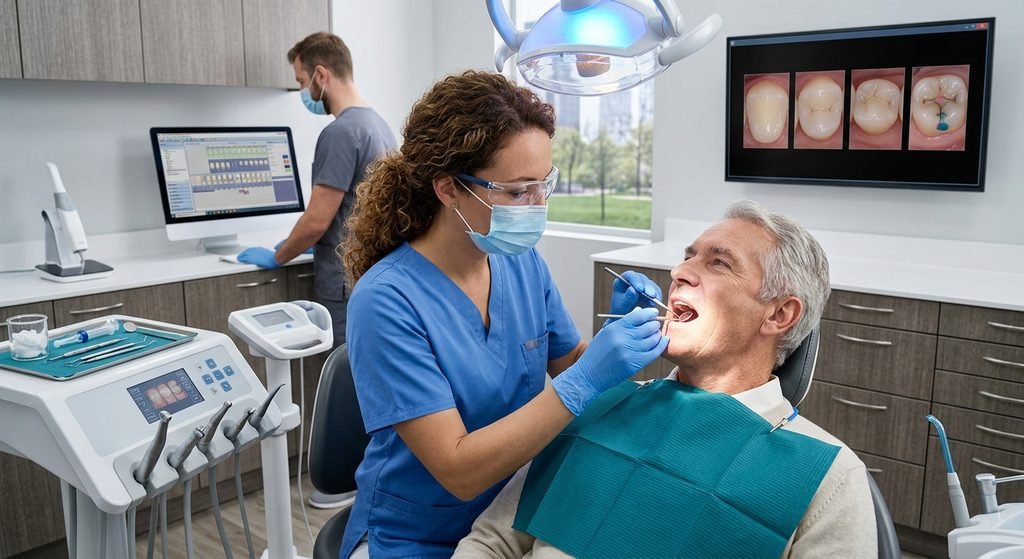
Do’s and Don’ts Between Dental Visits
What you do at home between appointments matters just as much as the checkup itself. Here’s a quick, practical breakdown.
| Do | Don’t |
|---|---|
| Brush twice daily with fluoride toothpaste | Skip flossing because brushing “feels like enough” |
| Floss once a day, even if gums bleed slightly at first | Ignore bleeding gums for weeks on end |
| Replace your toothbrush every 3 months | Use a worn-out, frayed toothbrush |
| Limit sugary snacks and sipping drinks all day | Assume “no pain” means “no problem” |
| Book checkups every 6 months (or as advised) | Wait for pain before scheduling an appointment |
| Mention any new symptoms, even minor ones | Self-diagnose and delay professional advice |
How Often Should You Really Go?
The commonly recommended interval is every six months, though your dentist may adjust this based on your personal risk factors — things like a history of cavities, gum disease, smoking, dry mouth, or certain medical conditions. Someone with excellent oral health and low risk might be fine stretching to once a year, while someone managing active gum disease might need visits every three to four months.
As Empire Bay Dental notes in their discussion on the importance of checkups, consistency matters more than perfection — showing up regularly, even when everything seems fine, is what allows small issues to be caught while they’re still simple and inexpensive to treat.
Bringing It All Together
It’s tempting to treat “no pain” as a green light to skip the dentist for another year, or two, or five. But your mouth doesn’t send out warning signals the way you’d expect. Decay, gum disease, and even oral cancer can all progress quietly, hidden from view and free of discomfort, until the problem has already grown into something bigger, costlier, and harder to reverse. A routine dental examination isn’t about looking for something you already suspect is wrong — it’s about confirming that everything actually is right, and catching the handful of things that aren’t before they turn into something you’ll definitely feel.
Preventive dental care, professional cleanings, timely X-rays, and oral cancer screenings all work quietly in the background, protecting not just your smile but your overall health. So, the next time you think about cancelling that six-month checkup because “everything’s fine,” remember that’s exactly the point when the appointment does the best.