

Carrots are one of the most nutritious and widely eaten vegetables, valued for their impressive health benefits, high fiber content, and rich supply of vitamins and antioxidants. But what are the advantages and disadvantages of eating carrots? While they can support eye health, digestion, immunity, and even weight management, eating too many carrots may also lead to a few unwanted side effects. In this guide, we’ll explore both the benefits and the potential drawbacks of carrots, helping you understand how to enjoy them as part of a healthy, balanced diet.

A Quick Introduction to Carrots
The carrot, known scientifically as Daucus carota, is a root vegetable that has been part of human diets for thousands of years. It started out mostly purple and white, and the bright orange variety we know today became popular a few centuries later. Carrots grow underground, pulling nutrients from the soil, and they are harvested in a wide range of colours, including orange, purple, yellow, red, and white. Each colour carries a slightly different mix of plant pigments, but all of them share a similar nutritional backbone: fibre, vitamin A precursors, and a handful of antioxidants.
Carrots are low in calories, naturally sweet, and versatile enough to be eaten raw, steamed, roasted, juiced, or blended into soups. That versatility is one of the reasons they are recommended so often by dietitians — they are an easy vegetable to like, and an easy one to keep eating consistently.
Nutritional Profile of Carrots
Before getting into the advantages and disadvantages, it helps to know what is actually inside a carrot. A half-cup serving of raw carrots is genuinely nutrient-dense for how few calories it carries.
| Nutrient | Approximate Amount (per ½ cup raw) | Why It Matters |
| Calories | ~25 kcal | Low-calorie, filling snack option |
| Beta-carotene | 4,000–8,000 mcg | Converts to vitamin A in the body |
| Fibre | 1.7 g | Supports digestion and fullness |
| Vitamin A | Up to 51% of Daily Value | Supports vision and immunity |
| Vitamin K1 | Small but notable amount | Supports blood clotting and bone health |
| Potassium | ~200 mg | Helps regulate blood pressure |
| Vitamin C | Small amount | Supports collagen and immune function |
| Natural sugars | ~3 g | Gives carrots their mild sweetness |
Carrots are a particularly good source of beta-carotene, fiber, vitamin K1, potassium, and antioxidants, and they are low in calories. This is really the foundation of why carrots have such a strong nutritional reputation — they pack a lot of value into very few calories.
Advantage 1: Carrots Support Eye Health
This is the benefit carrots are most famous for, and it holds up well. One large carrot can provide 100% of the Daily Value for the cell-protective antioxidant vitamin A, which comes from two carotenoid pigments called alpha-carotene and beta-carotene. Vitamin A may help prevent age-related macular degeneration, a condition that causes vision loss, and a deficiency of it can lead to night blindness.
Beyond vitamin A itself, the antioxidants lutein and zeaxanthin found in carrots also support eye health by protecting the retina and the lens. So, the “carrots are good for your eyes” advice from childhood turns out to be grounded in real nutritional science, even if carrots alone won’t cure existing vision problems.
Advantage 2: Carrots Strengthen the Immune System
Carrots do more than protect your eyesight — they also help your body fight off illness. Vitamins A and C in carrots both support the immune system, with vitamin A helping form and protect the mucous membranes that line the respiratory, digestive, and urogenital tracts and keep germs out of the body.
Separately, research on beta-carotene backs this up further. Studies show that beta-carotene in carrots protects phagocytic cells from damage and boosts the response of T and B lymphocytes against harmful bacteria and viruses. In simple terms, carrots give your immune system some extra ammunition.
Advantage 3: Carrots Are Good for Heart Health
Heart health is another area where carrots quietly do a lot of work. Studies have linked eating carrots to lower cholesterol levels. This effect is largely credited to the soluble fibre in carrots.
Potassium plays a role here too. Potassium in carrots helps regulate blood pressure by sweeping excess sodium and fluid out of the body, which takes pressure off the heart. On top of that, phenolic compounds in carrots may lower the risk of cardiovascular disease through antioxidant effects that help control blood sugar and cholesterol levels, both major risk factors for heart disease and stroke.
Advantage 4: Carrots Aid Digestion and Weight Management
If you’re trying to manage your weight without feeling constantly hungry, carrots are a smart choice. Carrots are low in calories and high in fiber content, which keeps a person from overeating, and they also help with bile secretion, which supports fat burning and weight loss.
Fiber also does a lot of quiet work in the gut. Carrots provide both soluble and insoluble fibre, which may support digestion and heart health, and they can feed the friendly bacteria in the gut, potentially improving overall health and lowering disease risk.
Advantage 5: Carrots Promote Healthy Skin
Carrots are sometimes called a “beauty food,” and there’s a nutritional reason behind that nickname. Beta carotene, an antioxidant found in carrots, may help protect the skin from sunburn and slow down skin aging by improving elasticity, hydration, texture, wrinkles, and age spots. Vitamin C in carrots also supports skin health by helping the body produce collagen, a protein that supports skin structure, elasticity, strength, and cell turnover.
Advantage 6: Carrots May Lower Cancer Risk
This benefit is still being researched, but early evidence is encouraging. The lycopene in carrots may help lower the risk of heart disease and certain cancers. Antioxidant-rich vegetables like carrots are generally associated with lower rates of chronic disease, though carrots should be viewed as one piece of a broader healthy-eating pattern rather than a stand-alone cure.
Advantage 7: Carrots Are Good for Teeth and Gums
Carrots are also surprisingly good for your mouth. Chewing carrots scrubs the teeth, removing harmful plaque buildup from the enamel and surface stains, leaving a brighter smile. This “nature’s toothbrush” effect is one of the more overlooked perks of snacking on raw carrots instead of processed snacks.
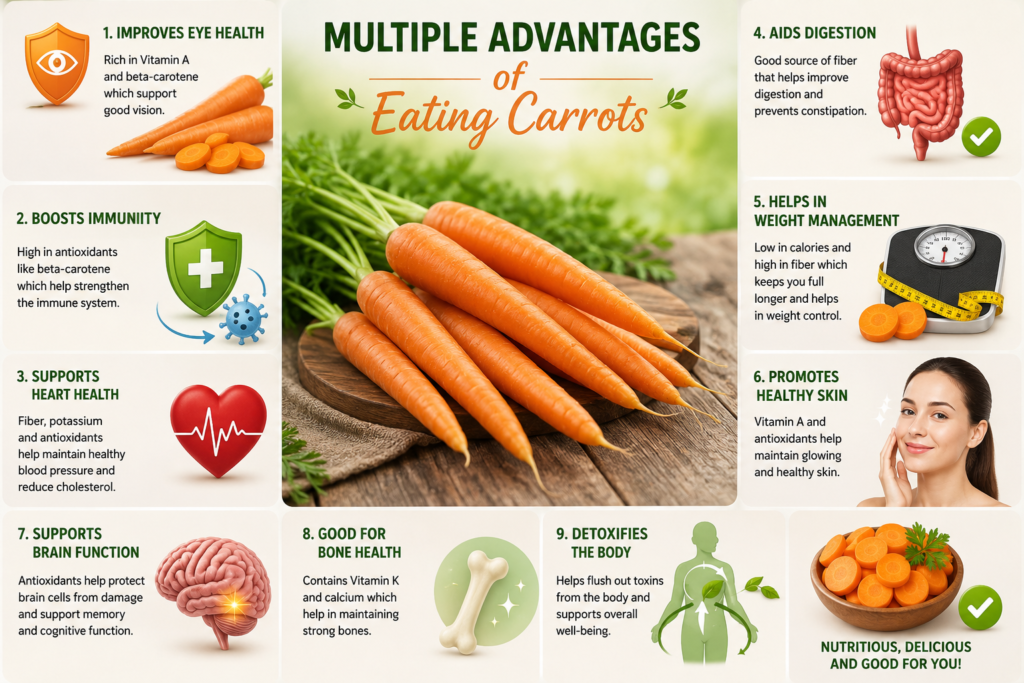
Summary Table: Advantages of Eating Carrots
| Advantage | Key Nutrient Involved | Main Benefit |
| Better eyesight | Vitamin A, lutein, zeaxanthin | Protects retina, may slow macular degeneration |
| Stronger immunity | Vitamin A, Vitamin C | Protects mucous membranes, fights infection |
| Heart health | Fibre, potassium, phenolic compounds | Lowers cholesterol, regulates blood pressure |
| Weight management | Fibre, low calories | Keeps you full, supports fat burning |
| Digestive health | Soluble and insoluble fibre | Feeds gut bacteria, prevents constipation |
| Skin health | Beta-carotene, Vitamin C | Slows aging, supports collagen production |
| Lower cancer risk | Lycopene, antioxidants | Associated with reduced chronic disease risk |
| Dental health | Crunchy texture | Scrubs plaque, removes surface stains |
Disadvantage 1: Carotenemia (Orange or Yellow Skin)
Now let’s turn to the downsides, because eating too many carrots is not entirely risk-free. The most well-known side effect is a condition called carotenemia. This occurs when excess beta-carotene, the pigment responsible for carrots’ orange color, accumulates in the bloodstream, and it is most noticeable on thicker skin areas like the palms, soles, elbows, knees, and around the nose.
The good news is that this condition is not dangerous. Carotenemia is usually seen in young children, is not toxic, and generally does not cause other health problems, though it may take several months for the skin to return to its normal color after switching to a lower-carotene diet. A dermatologist at Cleveland Clinic put a number on how much carrot intake triggers this: one medium carrot has about 4 milligrams of beta-carotene, so eating around 10 carrots a day for a few weeks, or taking beta-carotene supplements, could lead to carotenemia.
Disadvantage 2: Digestive Discomfort From Too Much Fiber
Fiber is usually framed as a benefit, but more is not always better. Eating large amounts of carrots can contribute to excessive fiber intake, which may cause constipation or diarrhea in some people. If you suddenly increase your carrot intake — say, by starting a juicing habit or a new diet plan — your gut may need time to adjust and bloating or irregular bowel movements can show up in the meantime.
Disadvantage 3: Rare Allergic Reactions
Allergies to carrots are uncommon, but they do happen, especially in people who are already sensitive to related plants like celery or birch pollen. Though rare, some individuals may experience itching, swelling, or breathing difficulties after consuming carrots and should seek medical advice if this happens. If you notice any of these symptoms after eating carrots, it is worth speaking with a doctor rather than brushing it off.
Disadvantage 4: Possible Vitamin A Complications in Extreme Cases
While the body is generally good at regulating how much beta-carotene it converts into active vitamin A, extreme overconsumption over a long period has led to real complications in isolated cases. In one extreme case, someone eating six to seven pounds of carrots per week developed constipation, elevated liver enzymes, and possible vitamin A toxicity. Cases like this are rare, but they are a useful reminder that “natural” foods still have an upper limit that shouldn’t be ignored.
Disadvantage 5: Natural Sugar Content
Carrots are sweeter than many other vegetables, and while their natural sugar is nowhere near a health concern for most people, it is worth being mindful of for anyone closely managing blood sugar. Since carrots naturally contain sugar, pairing them with healthy fats or proteins can help keep blood sugar levels more stable. This is a minor point for most healthy adults, but it matters more for people managing diabetes or following very low-carbohydrate diets.

Summary Table: Disadvantages of Eating Carrots
| Disadvantage | Cause | How Serious Is It? |
| Carotenemia (orange/yellow skin) | Excess beta-carotene buildup | Harmless, reversible over weeks or months |
| Digestive discomfort | Too much fibre at once | Mild, usually resolves with moderation |
| Allergic reactions | Sensitivity related to celery/birch pollen | Rare, but can be serious if it occurs |
| Vitamin A related complications | Extremely high, sustained intake | Very rare, tied to extreme overconsumption |
| Blood sugar impact | Natural sugar content | Minor, mainly relevant for diabetics |
Do’s and Don’ts of Eating Carrots
To make the most of carrots while avoiding the downsides, it helps to keep a simple set of habits in mind.
| Do’s | Don’ts |
| Eat 1–2 medium carrots a day for solid nutritional benefits | Don’t eat 10+ carrots daily for weeks at a time |
| Pair carrots with a source of healthy fat to absorb beta-carotene better | Don’t rely on carrot juice alone as a meal replacement |
| Wash and peel carrots properly before eating | Don’t ignore itching or swelling after eating carrots |
| Introduce more fibre gradually if you’re not used to it | Don’t suddenly triple your carrot intake overnight |
| Include a variety of vegetables, not just carrots | Don’t assume more carrots always means more benefits |
How Many Carrots Should You Eat Per Day?
Moderation really is the key word here. Staying under three to four large carrots a day keeps you well below the beta-carotene threshold linked to carotenemia, and even one or two carrots a day gives a substantial portion of daily vitamin A needs without any realistic risk of side effects. For most healthy adults, this is a very achievable and sustainable target — it fits easily into salads, snacks, or a side dish at dinner.
Carrots vs Carotenemia vs Jaundice: A Useful Distinction
One thing worth clarifying, because it can genuinely cause anxiety, is the difference between carotenemia and jaundice. The yellow-orange skin caused by too many carrots can be mistaken for jaundice, which signals a liver problem, but there is one reliable way to tell them apart: jaundice turns the whites of the eyes yellow, while carotenemia does not. If your skin looks a little orange but your eyes are perfectly white, beta-carotene is almost certainly the reason, and there is no need to panic.
Final Thoughts
Carrots earn their reputation as a healthy food. They support your eyes, your immune system, your heart, your digestion, your skin, and even your teeth — all from a vegetable that costs very little and requires no preparation skill to enjoy. The disadvantages, on the other hand, mostly show up only when carrots are eaten in genuinely excessive amounts, and even then, the most common side effect — orange-tinted skin — is harmless and temporary.
The real takeaway is balance. A couple of carrots a day, eaten alongside a varied diet of other vegetables, fruits, proteins, and whole grains, will give you nearly all of the benefits described above with essentially none of the downsides. Like most foods, carrots are not magic, and they are not dangerous either — they are simply a genuinely good vegetable that rewards consistent, moderate use.