

How to Become a Registered Optometrist in Australia: The COE Exam Explained
Australia is one of the better places in the world to practice eye care. There’s high clinical autonomy, a broad diagnostic scope, solid earning potential. With an aging population and steady demand across regional and metro areas, overseas-trained optometrists keep looking for a way in.
But practicing legally means registering with the Optometry Board of Australia (OBA), overseen by AHPRA. For international graduates, the way in is the Competency in Optometry Examination (COE), run by OCANZ.
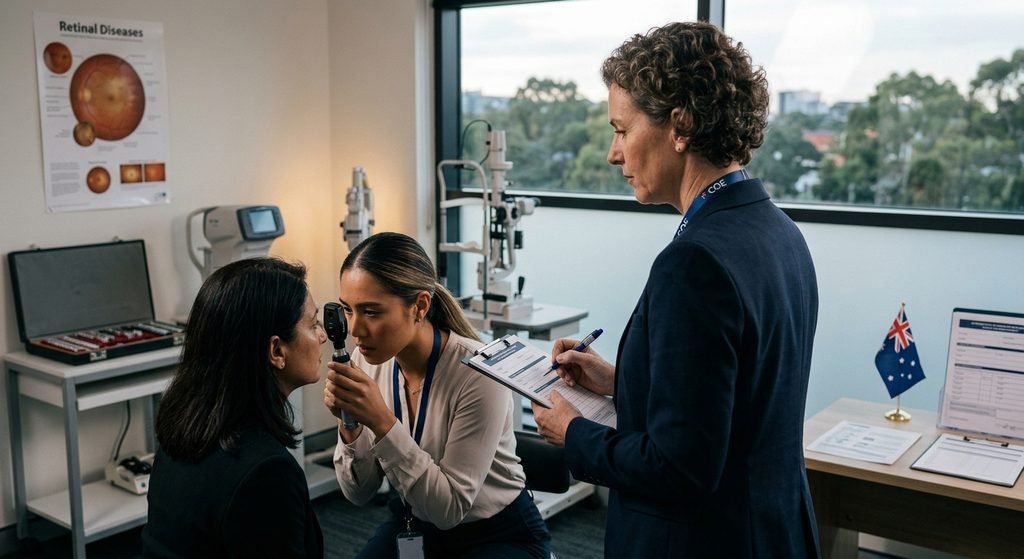
Here’s how the licensing process, the exam itself, and registration actually work.
Australian Optometry Licensing at a Glance
- Assessment authority: Optometry Council of Australia and New Zealand (OCANZ)
- Statutory regulator: Optometry Board of Australia (OBA) / AHPRA
- Main exam: Competency in Optometry Examination (COE)
- Core components: Eligibility Assessment, Written Exam, Cultural Safety Training, Clinical Examination
- English requirement: IELTS Academic (7.0 overall, no band below 7.0), OET (B grade), or PTE Academic (66+)
What Is the OCANZ COE Exam?
The COE is OCANZ’s way of confirming overseas-trained optometrists know as much and can do as much as an Australian graduate. Pass it, and you get a recognized certificate of competence, required for both skilled migration visas (Subclasses 189, 190, 491) and general OBA registration.
Step 1: Eligibility and Qualifications Assessment
Before sitting any exam, OCANZ checks your overseas qualifications first.
You’ll need an optometry degree equal to at least four years of full-time study, or a three-year degree plus one year of supervised clinical practice. Your coursework has to genuinely cover optical, visual, and biomedical sciences, backed by documented patient consultations. Your degree also needs to allow independent practice in your country of training.
Step 2: How the COE Exam Is Structured
The COE runs across three stages, each gating the next.
First, the written exam. Remote and online-proctored, so you can sit it from home. Two parts: a 3-hour multiple-choice paper on clinical science (optics, vision science, biomedical fundamentals), and a 3-hour short-answer exam working through patient cases, diagnostic findings, and management decisions.

Then, cultural safety training. A self-paced online module covering cultural competency and healthcare delivery for Aboriginal and Torres Strait Islander peoples.
Finally, the clinical exam, held in person at the Australian College of Optometry in Melbourne. Two parts here too, practical skills stations (slit-lamp bio microscopy, binocular indirect ophthalmoscopy, applanation tonometry, gonioscopy), plus live patient examinations testing history-taking, diagnostic accuracy, and communication.
Pass all three stages and you get a Positive Skills Certificate, which clears you for OBA registration.
Australian clinical standards lean heavily on evidence-based management and therapeutic reasoning, a step up for many international candidates. Many turn to Academically’s COE exam preparation course for that reason, live case simulations, clinical protocols, and exam strategy from optometrists who’ve already cleared the COE.
Step 3: Meeting OBA Registration Standards
Once you’ve passed the COE, you can apply for OBA registration. A few requirements:
- English proficiency: IELTS Academic (7.0 overall), OET (B grade), or PTE Academic (66+)
- A criminal history check, international and Australian, via Fit2Work
- Professional Indemnity Insurance meeting AHPRA’s standards
- Optionally, an Ocular Therapeutics Endorsement, the base COE gives general registration, but prescribing scheduled drugs needs the Assessment of Competence in Ocular Therapeutics (ACOT) or an approved postgraduate therapeutics course

Find jobs for optometrists in Australia
Once you’re credentialed, work tends to show up in a few places. Healthcare-specific portals like Jobslly are a good starting point as general job boards are overloaded.
- Regional and rural clinics offer higher pathology exposure and broader clinical scope, plus stronger salary packages and faster pathways for skilled regional visas.
- Corporate optical chains run high patient volumes, mostly routine refraction and contact lens work, but come with structured onboarding, newer equipment, and often relocation support.
- Ophthalmology shared-care roles put you closer to glaucoma and diabetic retinopathy management, surgical pre- and post-op care — good for more advanced, interdisciplinary exposure.
Conclusion
Getting registered as an optometrist in Australia isn’t quick — it takes real academic verification, sharp clinical reasoning, and focused exam prep. Get through the COE and align your practice with Australian standards, and a rewarding career is genuinely within reach.