

Stress Fracture in Foot is a common overuse injury that often starts as a mild ache but can quickly become painful if ignored. If you’ve ever noticed persistent pain on the top or side of your foot that doesn’t improve with rest, you may be dealing with more than a simple sprain or bruise. Many people dismiss the discomfort at first, only to discover later that tiny cracks have formed in one of the foot bones due to repeated stress.
A stress fracture foot injury is especially common among runners, dancers, athletes, hikers, and even people who suddenly increase their walking, exercise intensity, or wear unsupportive footwear. Unlike a bone broken in a single accident, a foot stress fracture develops gradually as repeated impact weakens the bone over time. Understanding the common causes and early warning signs is essential because prompt treatment can prevent the injury from worsening.
In this complete guide, you’ll learn how to recognize the symptoms, understand the diagnosis, discover the best ways to heal a foot stress fracture, and follow the right recovery plan. Whether your injury is mild or more advanced, knowing what to do early can help you recover faster, avoid complications, and safely return to your daily activities or favorite sports.
What Exactly Is a Stress Fracture in the Foot?
A stress fracture is a small, hairline crack in a bone that forms when the muscles around it become too tired to absorb the shock of repeated impact. When the muscles can no longer do their job, that shock gets transferred straight to the bone. Over time, the bone develops micro-damage faster than it can repair itself, and eventually a crack appears.
The foot is particularly prone to this because it carries the entire weight of the body with every single step. There are 26 bones in the human foot, and several of them, especially the metatarsals (the long bones that connect the midfoot to the toes), are frequent targets. A stress fracture in top of foot cases usually involves the second or third metatarsal, since these bones bear the most pressure during walking and running.
People often confuse this injury with a regular sprain or tendonitis, which is exactly why so many cases go untreated for weeks. Recognizing the difference early can save you months of frustration.
Common Causes Behind Foot Stress Fractures
Most stress fractures do not happen because of one bad step. They build up gradually because of repetitive overload. Some of the most common causes include:
- A sudden increase in training intensity, distance, or frequency, especially in runners who ramp up mileage too quickly
- Switching from a soft running surface to a hard one, such as moving from a treadmill to concrete
- Wearing worn-out, unsupportive, or poorly fitted shoes
- Low bone density, often linked to osteoporosis, vitamin D deficiency, or hormonal changes
- Participating in high-impact sports like basketball, gymnastics, or long-distance running
- Flat feet or unusually high arches, which change how weight is distributed across the foot
- Poor nutrition, particularly low calcium and vitamin D intake, which weakens bone structure over time
Athletes returning from an injury who resume training too aggressively are also at high risk, since the bone has not yet regained its full strength.
Recognizing the Symptoms Early
One of the trickiest things about this injury is that it rarely announces itself with a dramatic moment of pain. Instead, it creeps in gradually. Paying attention to early stress fracture foot symptoms can make a massive difference in how quickly you recover.
Typical warning signs include:
- A dull, aching pain that worsens with activity and improves with rest
- Pain that becomes sharper and more localized over time, often pinpointed to one exact spot on the bone
- Swelling on the top or side of the foot
- Tenderness when you press directly on the affected area
- Bruising in some cases
- Pain that eventually occurs even during normal walking or standing, not just during exercise
A useful way many doctors describe it is that if you can point with one finger to exactly where it hurts, that is a strong signal of a bone-related injury rather than a soft-tissue strain, which tends to feel more spread out.
Foot Pain vs Stress Fracture: How to Tell the Difference
This is one of the most common questions people search for, and understandably so, because plenty of foot problems share overlapping symptoms. Comparing foot pain vs stress fracture side by side can help you figure out whether it is time to see a doctor.
| Feature | General Foot Pain (Strain, Tendonitis, Soreness) | Stress Fracture |
| Pain location | Spread out, general area | Pinpoint, one specific spot |
| Onset | Often sudden after activity | Gradual, worsens over days or weeks |
| Pain with rest | Usually eases quickly | Persists or lingers even at rest |
| Swelling | Mild or none | Often present, localized |
| Pain with direct pressure | Mild discomfort | Sharp, distinct tenderness |
| Pain pattern | Comes and goes | Progressively worsens with continued activity |
| Response to normal painkillers | Noticeable relief | Little to no relief |
If your pain fits more into the right-hand column, it is worth getting it checked rather than waiting it out.
Diagnosing a Stress Fracture
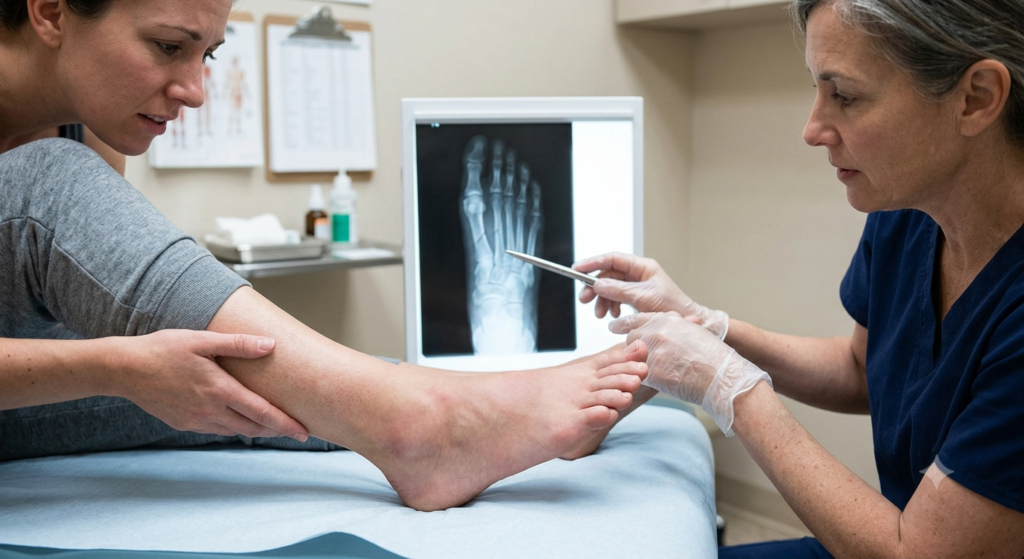
Doctors usually begin with a physical exam, applying gentle pressure to the suspected area to check for tenderness. Because pain from a stress fracture is not spread over the whole foot but is typically limited to the area directly over the injured bone, this pressure test is often the first clue.
Imaging is the next step, though it comes with a catch. Since a stress fracture starts as a tiny crack, it is often difficult to see on an initial X-ray, and the fracture may not become visible until several weeks later, once a healing bone called callus has started to form around the fracture site. This is why doctors sometimes order an MRI or bone scan when a stress fracture is suspected but does not show up clearly on the first X-ray.

Metatarsal Stress Fracture Foot: The Most Common Type
Among all the bones in the foot, the metatarsals are hit the hardest. A metatarsal stress fracture foot injury usually develops in the second or third metatarsal because these bones absorb the greatest load when you push off the ground while walking or running.
Not all metatarsal fractures are equal, though. Location matters a great deal when it comes to healing time and risk of complications:
| Metatarsal Fracture Location | Typical Healing Time | Notes |
| Second or third metatarsal shaft | 6–8 weeks | Most common, generally heals well with rest |
| Fifth metatarsal base (Jones fracture) | 12–16 weeks | Limited blood supply makes healing slower and less predictable |
| Navicular bone (midfoot) | 12–20 weeks | Prone to poor blood flow, higher risk of nonunion |
| Sesamoid bones (under big toe) | Variable, often prolonged | Can be stubborn and sometimes requires prolonged immobilization |
These injuries affect the long bones connecting the midfoot to the toes and represent the most common foot stress fracture type, with second and third metatarsal fractures typically healing within six to eight weeks with proper rest and treatment. However, the fifth metatarsal presents unique challenges, particularly at the base of the bone, where healing can take twelve to sixteen weeks because of limited blood supply in that area.
The navicular bone deserves special mention here too, since it is notoriously tricky. Because poor blood circulation makes navicular injuries particularly problematic, they often require longer recovery periods of twelve to twenty weeks.
Stress Fracture Foot Treatment Options
The good news is that the vast majority of stress fractures heal without surgery. Treatment focuses on one central idea: reduce the load on the bone long enough for it to repair itself naturally.
Common stress fracture foot treatment approaches include:
- Rest and activity modification – avoiding the activity that caused the injury in the first place
- Protective footwear – a stiff-soled shoe, a walking boot, or a fracture brace to limit motion at the injury site
- Crutches – used temporarily if weight-bearing causes significant pain
- Ice and elevation – to control swelling, especially in the first couple of weeks
- Pain management – doctors typically prefer acetaminophen over NSAIDs like ibuprofen or naproxen, because NSAIDs can slow bone healing
- Nutritional support – calcium and vitamin D supplementation to support bone repair
- Bone stimulator devices – sometimes recommended for slow-healing fractures or high-risk locations
- Surgery – reserved for severe cases, high-risk fracture locations with poor blood supply, or athletes who need a faster return to competitive sport
Treatment generally aims to lessen the bone’s weight-bearing load until it heals, and this often means wearing a walking boot or brace, or using crutches. In some cases, surgery is needed to help a stress fracture heal completely, particularly for fractures in areas with a poor blood supply.
Do’s and Don’ts While Recovering
Recovery is not just about waiting for time to pass. What you do (and avoid doing) during the healing window has a real impact on whether the bone heals cleanly or the injury drags on.
| Do’s | Don’ts |
| Rest the foot and avoid weight-bearing activities as advised | Don’t push through pain hoping it will “work itself out” |
| Wear the prescribed boot, brace, or supportive shoe consistently | Don’t skip follow-up appointments or imaging checks |
| Eat a calcium and vitamin D rich diet | Don’t take NSAIDs regularly without your doctor’s approval |
| Switch to low-impact cross-training like swimming or cycling once cleared | Don’t return to running or high-impact sport too early |
| Elevate and ice the foot in the early stages to reduce swelling | Don’t ignore new or worsening pain during recovery |
| Gradually reintroduce activity following a doctor’s return-to-sport plan | Don’t wear old, worn-out, or unsupportive shoes once you resume activity |
| Address underlying issues like low bone density or nutritional gaps | Don’t assume the fracture is fully healed just because pain has stopped |
Stress Fracture Foot Healing Time: What to Expect
Every case is a little different, but understanding stress fracture foot healing time in general terms helps set realistic expectations.
It typically takes about six to eight weeks for a stress fracture to heal for most common, low-risk locations. During that window, switching to gentler alternative activities such as swimming and cycling is usually recommended to maintain fitness without stressing the injured bone.
That said, timing matters enormously. Because these injuries can take eight to sixteen weeks to heal completely, and recovery time depends heavily on the severity of the fracture and activity level during healing, delaying treatment can turn what should have been a straightforward recovery into a much longer ordeal. In fact, stress fractures that go untreated can progress from hairline cracks to complete breaks, turning what might have been a six-week recovery into a four to six month process instead.

Here is a general breakdown of what a typical recovery timeline can look like:
| Recovery Phase | Approximate Timeframe | What Usually Happens |
| Acute phase | Weeks 0–2 | Rest, immobilization, pain and swelling management |
| Early healing | Weeks 2–6 | Continued protection, gradual reduction of weight-bearing restrictions |
| Bone consolidation | Weeks 6–10 | Imaging may confirm healing progress, gentle reintroduction of activity |
| Return to activity | Weeks 8–16+ | Gradual, staged return to normal training with close monitoring |
High-risk fractures, such as those in the navicular bone or the base of the fifth metatarsal, often require a more cautious, extended timeline and closer medical supervision throughout.
How to Heal a Foot Stress Fracture Faster
While there is no shortcut around the biological process of bone healing, there are practical steps that genuinely support faster, more complete recovery. If you are wondering how to heal a foot stress fracture as efficiently as possible, focus on the following:
- Get diagnosed early. The sooner treatment starts, the shorter the recovery tends to be.
- Actually, rest. This sounds obvious, but many people quietly keep training through pain, which is the single biggest reason recoveries drag on.
- Support your bone health nutritionally. Adequate calcium, vitamin D, and overall caloric intake matter, especially for athletes at risk of relative energy deficiency.
- Follow the weight-bearing restrictions exactly as prescribed, rather than guessing at what feels okay.
- Ease back into activity gradually, following a structured return-to-sport plan rather than jumping straight back into your old routine.
- Address the root cause. If poor footwear, training errors, or biomechanical issues caused the fracture, fixing those factors helps prevent a repeat injury.
- Don’t rely on pain alone as your guide. Pain can disappear before the bone is fully healed, which is why some doctors recommend imaging confirmation before a full return to high-impact sport.
Preventing Future Stress Fractures
Once you have gone through a stress fracture, the risk of it happening again is genuinely higher, which makes prevention worth taking seriously. People with a history of a previous stress fracture tend to be more susceptible to developing another one, so adjusting training habits, nutrition, and other risk factors becomes an important part of long-term foot health rather than an optional afterthought.
Some practical prevention strategies include:
- Increasing training intensity or distance gradually, following the general rule of no more than about a 10 percent increase per week
- Replacing worn-out athletic shoes regularly
- Cross-training to reduce repetitive impact on the same bones
- Getting bone density checked if you have risk factors such as a history of fractures, hormonal imbalances, or a family history of osteoporosis
- Maintaining a nutrient-rich diet that supports bone strength
- Listening to early warning signs of pain instead of pushing through them
When to See a Doctor
Not every ache in your foot needs a doctor’s visit, but certain signs should never be ignored. If you notice persistent pain that worsens with activity and does not improve with a few days of rest, swelling that does not go down, or pain sharp enough to change how you walk, it is time to get it checked. Waiting it out rarely pays off with this particular injury, since continuing to walk or run on an undiagnosed stress fracture can push a small crack toward a full break.
Final Thoughts
A stress fracture in the foot is a frustrating injury precisely because it is so easy to dismiss in its early stages. That dull ache after a long run or a busy day on your feet can feel like nothing worth worrying about, right up until it isn’t. Paying attention to early symptoms, getting an accurate diagnosis, and committing to the rest period your body actually needs are the three things that separate a smooth six-to-eight week recovery from a drawn-out, complicated one. If you are dealing with unexplained foot pain that fits the pattern described here, do not wait for it to become a bigger problem. A short conversation with a podiatrist or orthopedic doctor now can save you months of setbacks later.